
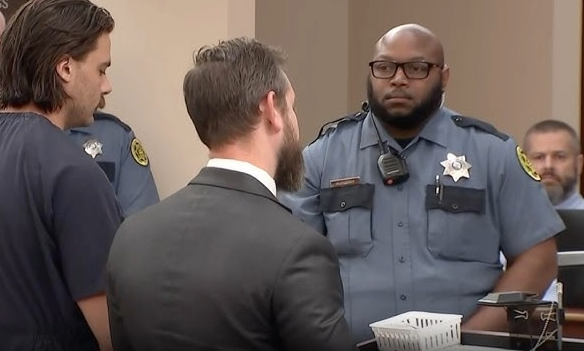
A Tennessee livestreamer known online as “Chud the Builder” is facing attempted murder and multiple felony gun charges after prosecutors say Dalton Eatherly shot a man several times outside a courthouse in broad daylight.
Dalton Eatherly, 28 — who streams under the name “Chud the Builder” — was ordered held on a $1.25 million bond after the shooting outside the Montgomery County Courthouse in Clarksville. Authorities say the violence erupted during an argument Wednesday afternoon and unfolded in front of multiple bystanders near the courthouse entrance.
According to court records, Eatherly allegedly turned toward another man, Joshua Fox, reached for a handgun and fired during a physical altercation. Investigators say Fox was struck multiple times and airlifted to Vanderbilt University Medical Center for emergency surgery.

Prosecutors have charged Eatherly with attempted criminal homicide, employing a firearm during a dangerous felony, aggravated assault and reckless endangerment with a deadly weapon. Tennessee Judge Reid Poland III cited both the seriousness of the allegations and the number of people near the courthouse when setting bond at $1.25 million.
Attempted criminal homicide in Tennessee can carry a prison sentence of between 15 and 60 years.
Authorities also say surveillance footage captured bullets ricocheting near surrounding courthouse walls while civilians were nearby during the shooting shortly after 1:20 p.m.
Prosecutors Highlighted Eatherly’s Online History
Eatherly has built an online following through livestreams containing racial slurs and inflammatory confrontations. Videos reviewed by investigators allegedly show him targeting Black people and other minorities while repeatedly using racist language.
After the shooting, Eatherly reportedly livestreamed himself speaking with first responders while claiming he acted in self-defense. In the video, he alleged members of a group had mocked him before a confrontation escalated into violence.
Fox was initially detained after the shooting before later being released by investigators.
Eatherly was also injured during the incident and transported to hospital before later being booked into custody.
Defense Attorney Says Case Has Triggered Threats
Attorney Jake Fendley, who was appointed to represent Eatherly after the Public Defender’s Office withdrew, said his office has received threatening calls and emails since taking the case.
Fendley stated that legal representation applies regardless of a defendant’s “race, religion, ideology, or allegations,” while also describing racism as “a terrible thing and a flawed method of thinking.”
A preliminary hearing is scheduled for May 26.
Previous Arrest Days Before Courthouse Shooting
The courthouse violence came less than a week after Eatherly was arrested in Nashville following another alleged disturbance tied to his livestreaming activity.
Police say restaurant staff asked him to stop livestreaming and behaving disruptively inside the business before he allegedly began yelling racial remarks and refused to pay a $371.55 bill.
He was later arrested on charges including theft of services, disorderly conduct and resisting arrest before being released on a $5,000 bond.
Court records also showed Eatherly had a hearing scheduled at the same courthouse Wednesday morning in a separate civil debt case involving roughly $3,300 allegedly owed to a credit management company.
How Tennessee Self-Defense Law Could Shape the Case
Eatherly’s claim that he acted in self-defense will sit at the center of the criminal case as investigators piece together exactly what happened outside the Montgomery County Courthouse.
Under Tennessee law, jurors will ultimately have to decide whether Eatherly believed he was in immediate danger before opening fire. But the case may also hinge on whether the shooting itself is viewed as a reasonable response to the confrontation prosecutors say unfolded in a crowded public area.
Court records state Joshua Fox was struck multiple times, while investigators say bullets ricocheted near courthouse walls with bystanders nearby. Those details could strengthen the state’s reckless endangerment allegations and increase focus on the public safety risks surrounding the shooting.
Attorneys on both sides are expected to dissect surveillance footage, witness accounts and the moments leading up to the gunfire. Eatherly’s own livestreams could also become part of the courtroom battle if prosecutors argue his online conduct helps explain the confrontation or his mindset before the shooting began.
With attempted criminal homicide carrying a possible sentence of up to 60 years in prison, the self-defense argument may ultimately determine whether the case ends in conviction, acquittal or a reduced charge.
Can Livestream Videos Be Used as Evidence in Criminal Cases?
Investigators are now combing through Eatherly’s livestream videos and social media history as the prosecution builds its case around the courthouse shooting.
Modern criminal investigations increasingly involve online broadcasts, recorded confrontations and social media activity, especially when violent incidents are captured or discussed publicly. In this case, authorities are likely to examine whether Eatherly’s online persona and repeated racial remarks help explain the events leading up to the shooting itself.
While offensive speech is generally protected under the First Amendment, videos posted online can still become evidence if prosecutors believe they show hostility, escalating behavior or a pattern of confrontations. Jurors in criminal trials are now regularly shown text messages, livestream clips and social media posts as prosecutors attempt to build a wider picture of a defendant’s behavior before an alleged crime.