
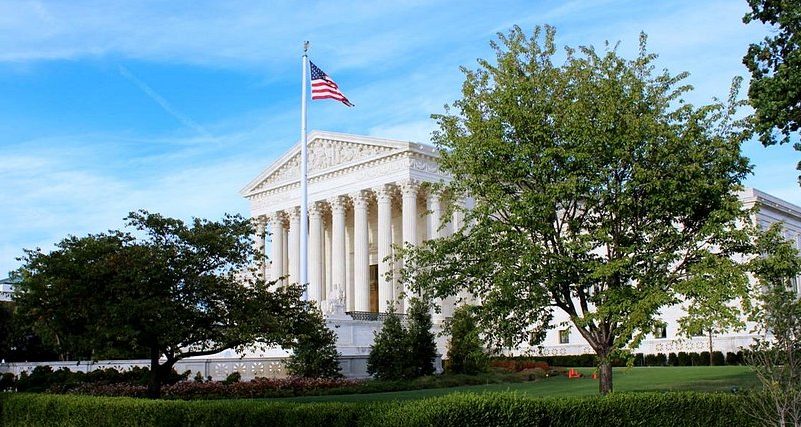
Roy Moore has asked the US Supreme Court to stay the mandate of the US Court of Appeals for the Eleventh Circuit in his defamation dispute with Senate Majority PAC, seeking to preserve the $8.2 million bond securing a jury award while he prepares a petition for certiorari.
The emergency application in Moore v Senate Majority PAC was directed to Justice Clarence Thomas, the circuit justice for the Eleventh Circuit. Moore argues that, without a stay, the appellate mandate will require the US District Court for the Northern District of Alabama to enter judgment for Senate Majority PAC and permit release of the supersedeas bond before the Supreme Court can decide whether to review the case.
The dispute arose from a political advertisement aired during Moore’s 2017 campaign for the US Senate. Moore alleged that the advertisement falsely implied he had solicited sex from a 14-year-old girl.
A federal jury found Senate Majority PAC liable on defamation-by-implication and false-light claims and awarded Moore $8.2 million in compensatory damages. The district court later denied the PAC’s renewed motion for judgment as a matter of law and its request for a new trial.
On 24 April 2026, the Eleventh Circuit reversed that judgment in Moore v Cecil and remanded the case with instructions to enter judgment for Senate Majority PAC. The appellate court held that a public figure pursuing a defamation-by-implication claim must prove that the publisher intended to communicate the defamatory implication, not merely that it knew a statement was false or acted with reckless disregard for its truth.
Moore’s application contends that the decision raises unresolved questions about the relationship between the First Amendment, the Seventh Amendment and appellate review of jury findings. It relies on New York Times Co v Sullivan, which established the actual-malice standard for public-figure defamation claims, and Masson v New Yorker Magazine, which addressed materially altered statements and false meaning.
The Eleventh Circuit denied Moore’s request to stay the mandate on 8 June 2026. His Supreme Court filing says the mandate was expected to issue on or about 15 June, after which the bond securing the jury judgment could be released. Moore maintains that this would create irreparable harm because the award might become practically unrecoverable even if the justices later granted review and reversed.
The application does not ask the Supreme Court to decide the merits at this stage. It asks only for preservation of the status quo while Moore seeks certiorari.
The response will be watched by solicitors, barristers and in-house counsel handling reputation, media and political speech disputes because it may clarify how appellate courts assess jury findings of actual malice.
Law firms advising publishers, campaign organisations and public figures may need to place greater emphasis on evidence of editorial intent and how combined words, images and sequencing communicate an allegedly defamatory meaning.