

Missing a client call doesn’t just cost you a conversation — it costs you a case. Here are the services keeping law firms responsive, professional, and competitive around the clock.
Every year, the gap between firms that win new clients and those that lose them quietly widens — and it often comes down to who picked up the phone. A secret shopper study commissioned as part of Clio’s Legal Trends Report tested 500 law firms and found that only 40% answered incoming calls — a figure the industry has shown little sign of improving on. The majority of practices are still handing potential clients directly to competitors. In 2026, that is no longer an acceptable operational reality.
Legal answering services have matured significantly. The best providers now go well beyond simple message-taking, offering structured intake, CRM integration, bilingual support, outbound follow-up, and seamless calendar management. Whether you run a solo practice or a multi-partner firm, the right service can meaningfully improve client conversion and free your attorneys to focus on billable work.
We assessed the leading providers across five criteria: intake depth, availability, pricing transparency, technology integration, and track record with legal clients. Here are our top five for 2026.
1. Veza Reception — Best for Boutique, High-Customisation Legal Intake
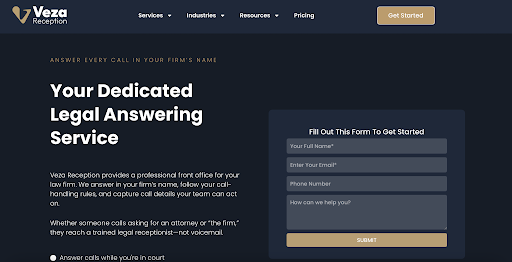
Founded specifically to serve law firms, Veza Reception has built its entire operation around one proposition: a dedicated pod of five to eight receptionists who learn your firm’s tone, intake rules, and qualifying criteria — and stick to them. This is a deliberate structural choice, and it matters. Larger services typically rotate calls across a pool of dozens of agents; any given caller may reach a different person every time, with varying familiarity with your firm’s scripts and priorities. Veza’s smaller, dedicated teams mean callers encounter the same familiar voices, receptionists develop a genuine feel for your practice over time, and errors from agents unfamiliar with your protocols become far less likely. For law firms where consistency and client trust are non-negotiable, that distinction is significant.
The service performs best when intake is rule-based and consistency in execution is a priority — different qualification rules per practice area, clear escalation paths for urgent matters, and specific disqualifiers applied without improvisation. Pricing is transparent and contract-free: plans run at $200 per month for 100 minutes, $429 for 250 minutes, $789 for 500 minutes, and $1,479 for 1,000 minutes, with custom plans available beyond that. A 14-day free trial is included, with no setup fees.
The tradeoff is scale. The dedicated pod model is a structural advantage for consistency, but it also means Veza is not the right fit for very high call volumes or firms whose needs shift dramatically month to month. The onboarding investment — building out scripts, intake rules, and escalation paths — is also more substantial than drop-in alternatives, which suits firms prepared to treat their front-of-house seriously, but may frustrate those looking for an immediate plug-and-play solution.
Best for: Solo to mid-sized firms that want a boutique, legal-only front desk with tight intake workflows, transparent pricing, and a team that sounds genuinely embedded in the practice.
2. Gabbyville — Best for Personalised, Client-Focused Call Handling
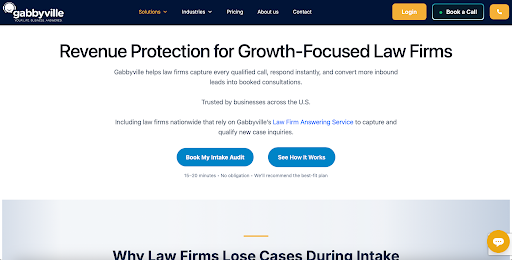
Gabbyville has built its reputation on the quality of individual caller interactions — its U.S.-based bilingual receptionists are known for warmth and personability, trained to follow firm-defined scripts while bringing genuine attentiveness to each conversation. The service supports law firms across a broad range of practice areas including personal injury, criminal defense, family law, immigration, and estate planning, and adds live chat alongside phone answering, with the first ten chats available at no additional cost before further usage is billed.
The key structural differentiator is pricing. Gabbyville bills per call rather than per minute, with plans ranging from $285 to $1,300 per month. For firms with longer client calls — detailed intake conversations that frequently run well beyond a standard two-minute interaction — per-call pricing provides meaningful cost predictability that per-minute models cannot match. There are no setup fees, no long-term contracts, and plans can be cancelled at any time.
The limitations worth flagging are coverage hours and legal specialism. Gabbyville’s live receptionists operate Monday through Friday, 8am to 8pm EST — not 24/7 — which is a meaningful constraint for practices like criminal defense or personal injury where after-hours calls carry urgency. The service also covers a wide range of industries beyond law, so firms requiring receptionists shaped exclusively by attorney workflows and legal intake conventions will need to weigh that carefully.
Best for: Firms that want warm, personalised call handling with predictable per-call pricing and live chat coverage, and whose inbound activity falls primarily within business hours.
3. Lawyer Line — Best Attorney-Exclusive Service
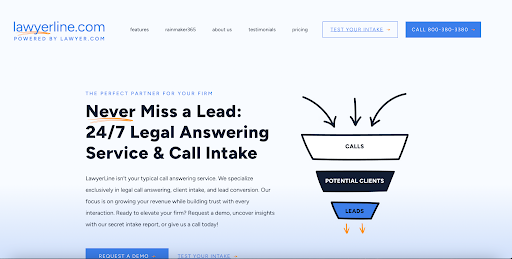
The case for a legal-only answering service rests on a simple premise: receptionists who handle nothing but law firm calls will, over time, develop a materially different understanding of those calls than agents rotating across industries. Lawyer Line is built entirely on that premise. A product of the Lawyer.com network — which has spent over eight years managing legal referral intake — Lawyer Line operates exclusively for attorneys, with U.S.-based bilingual receptionists trained across more than 140 practice areas and a 24/7/365 service that currently handles upwards of 100,000 calls per month across more than 800 law firms.
What separates Lawyer Line from services that simply answer and log is its intake architecture. Calls are not treated as messages to relay but as leads to evaluate: the team screens for case value, qualifies callers against your firm’s criteria, and routes only the right opportunities forward. That approach — closer to intake management than call answering — is reflected in a reported 99% client retention rate and a pay-as-you-go, no-contract model that suggests confidence in the service rather than reliance on lock-in. Integrations with Clio, Practice Panther, and Lawmatics mean intake data moves directly into the systems firms are already running.
The tradeoff is visibility on cost. Lawyer Line does not publish its rates, which makes upfront budget modelling harder than with providers who list pricing clearly. A free intake test on the website goes some way toward addressing that — it allows firms to hear exactly how their calls will be handled before any financial commitment is made — but firms that require cost certainty before trialling will need to go through a direct conversation first.
Best for: Solo attorneys and small firms that want a legal-exclusive service with genuine intake depth, active lead qualification, and the operational credibility of the Lawyer.com network behind it.
4. Moneypenny — Best for Scalable, Multi-Channel Legal Coverage
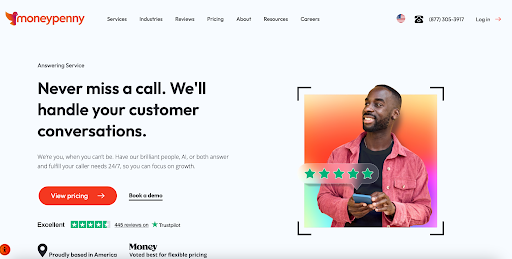
Most answering services train their receptionists in legal terminology. Moneypenny takes a different approach: it staffs its legal team with people who have already worked in legal environments — ex-paralegals, conveyancers, and legal secretaries who bring professional context to calls rather than acquiring it through a training programme. That distinction matters in practice. A receptionist who has spent time in a legal office understands the weight of an intake conversation differently from one who has learned to simulate it, and callers — particularly those contacting a firm under stress — tend to notice the difference.
That human expertise is augmented by a proprietary technology layer. Moneypenny’s KnowledgeBase surfaces client and firm information in real time during calls, and its MessageMaker tool generates accurate summaries immediately after each interaction — reducing the margin for error in message-taking and giving firms a reliable audit trail without manual effort. The service extends beyond telephony too: trained live chat agents handle web enquiries through the same platform, making Moneypenny one of the few providers that genuinely integrates both channels rather than treating chat as an afterthought. Plans scale across a broad range of usage, from 50 to 1,000 minutes per month, with 24/7/365 coverage and bilingual support throughout.
The tradeoff is twofold. Pricing starts at around $145 per month for the entry plan but climbs meaningfully once round-the-clock coverage, outbound calling, and other add-ons are included — the latter carrying a separate setup fee that merits scrutiny. And while Moneypenny’s legal credentials are genuine, it is not a legal-only provider. Firms for whom exclusive legal specialism is a non-negotiable will find that limitation relevant, even given the depth of experience the legal team brings.
Best for: Small to mid-sized firms that want a scalable, multi-channel service backed by staff with real legal experience and AI-enhanced call handling, and who are prepared to trade legal exclusivity for broader operational capability.
5. Abby Connect — Best General Answering Service for Law Firms
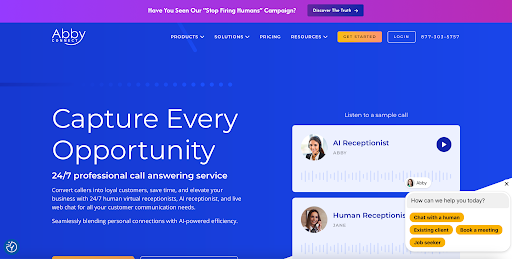
Founded in 2005 and based in Las Vegas, Abby Connect is a generalist virtual receptionist service with two decades of experience serving businesses across law, healthcare, home services, real estate, financial services, and more. The company reports having worked with over 2,000 law firms and has built out meaningful integrations to support them, including direct connections with Clio, Clio Grow, and Lawmatics. The service operates a hybrid model of US-based live receptionists and an AI layer that generates call summaries, transcripts, and caller sentiment scores after every interaction — useful tools for firms that want visibility into how their calls are handled without listening back to recordings. Live chat is also available as an add-on. Human receptionist plans are priced at $329 per month for 100 minutes, $599 for 200 minutes, and $1,380 for 500 minutes, with a 14-day free trial available.
The tradeoff is specialism. Abby is not a legal-only provider, and while its legal track record is genuine, firms will encounter receptionists whose training spans a wide range of industries rather than being exclusively shaped by attorney workflows. For practices where legal nuance, terminology, and sensitivity in intake conversations are paramount, the generalist model is a meaningful limitation — and one worth weighing honestly against the service’s otherwise strong credentials.
Best for: Law firms that want a capable, professional general answering service with legal integrations and do not require a legal-only provider.
A Note on Selection
The legal answering service market is crowded enough that surface-level comparisons — 24/7 availability, bilingual support, CRM integration — apply to most credible providers. The meaningful differentiators lie in intake depth, operational consistency, and whether a provider’s training is genuinely legal-specific or repurposed from general call centre work. Every firm’s call profile is different, and no single provider is the right answer across all practice sizes and types. Firms are well advised to trial their shortlisted options under realistic conditions before committing, and to review performance data regularly once a partnership is in place.
In 2026, the phone is still where cases are won and lost. The services above give law firms the best chance of being the ones that pick up.