
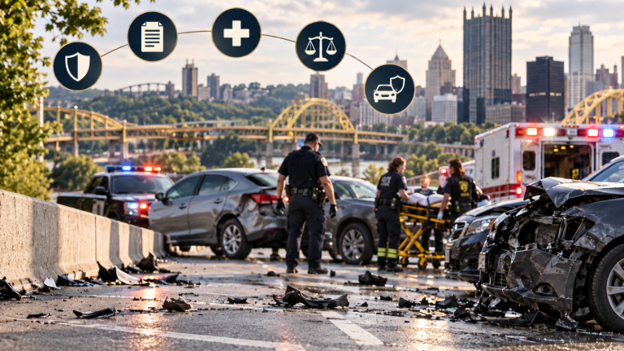
A strong legal guidance begins with protecting the evidence, understanding the coverage, and making sure the full impact of the crash is not overlooked.
If you are hurt, speaking with a car accident lawyer Pittsburgh PA can help you make sense of what happens next, especially when medical bills, insurance calls, and filing deadlines are already competing for your attention. An attorney can look closely at the available coverage, gather evidence before it is lost, and take over much of the back-and-forth with insurers so you have more time to deal with your recovery.
The First Days Can Shape The Claim
After a crash, your health should come first. Some injuries hurt immediately, while others take time to show up. Seeing a doctor soon after the accident can also help establish a clear timeline, because the medical notes can show when the pain started, what the doctor found, and what treatment was needed.
Keep photographs, repair estimates, witness information, medical bills, wage records, and insurance correspondence together. A lawyer can review these materials, obtain additional evidence, and look for gaps before an insurer uses missing information to question what happened or how the accident affected you.
Pennsylvania Insurance Rules Matter
Pennsylvania car insurance has state-specific rules. Drivers must carry at least $5,000 in medical benefits coverage, which can pay covered medical bills after an accident regardless of fault. State law also requires minimum bodily injury liability limits of $15,000 per person and $30,000 per accident, along with $5,000 in property damage liability coverage.
Pennsylvania drivers generally choose between full tort and limited tort coverage when they buy auto insurance. Full tort preserves the right to seek compensation for pain and suffering after a crash. Limited tort usually lowers the premium, but it can restrict that right unless the injuries are considered serious under Pennsylvania law or another legal exception applies.
Because the policy selection can affect a claim, a review of the declarations page and household policies may uncover options that are not obvious from the first insurance call.
Fault Is Not Always All Or Nothing
A Pittsburgh collision can involve more than one contributing decision. Pennsylvania follows a modified comparative negligence rule. You may still recover damages when your share of negligence is not greater than the defendant’s, but the amount awarded can be reduced according to your percentage of fault. Evidence becomes especially important when drivers disagree about speed, right of way, lane position, visibility, or distraction.
An experienced attorney can piece together what happened by reviewing the police report, photos, vehicle damage, available video, and statements from people who saw the crash. The goal is not simply to collect paperwork. It is to show how the crash happened and how the injuries changed your work, mobility, family responsibilities, and daily routine.
Pittsburgh Roads Bring Local Challenges
Pittsburgh drivers regularly encounter steep grades, bridges, tight intersections, construction zones, winter weather, rain, and changing visibility. Those conditions do not automatically determine fault, but they can affect what reasonable driving required at the time of a crash. Road design, traffic controls, lighting, maintenance, and weather may deserve attention in your case.
The city continues its Vision Zero initiative, using roadway design, education, policy, data, and crash response to reduce fatal and serious crashes. Pittsburgh reported 1,534 crashes in 2024 on city and state-owned roads excluding interstates, a 17 percent decrease from 2023. That progress is encouraging, but safer-street efforts do not erase the consequences for people who are injured.
Deadlines Can Arrive Before Recovery Does
Pennsylvania generally gives an injured person two years to file a lawsuit for personal injuries caused by negligence. Certain cases can involve different procedures or additional deadlines, particularly when a public entity may be involved. Waiting can make evidence harder to locate. Video may be overwritten, vehicles may be repaired, and witnesses may become harder to reach.
Early legal review can clarify the timeline without forcing you to make rushed decisions about settlement. It can also help distinguish immediate expenses from longer-term losses such as future treatment, reduced earning capacity, rehabilitation needs, or lasting limits on everyday activities.
Support Can Extend Beyond The Insurance Claim
Some crashes involve conduct that may also be criminal, such as impaired driving. In qualifying cases, Pennsylvania’s Victims Compensation Assistance Program can help crime victims and families with certain out-of-pocket expenses. A lawyer can help identify whether resources outside the ordinary auto claim may be relevant while coordinating evidence for the civil case.
A Consultation Can Bring The Next Steps Into Focus
After a serious collision, useful legal help should be specific to the person rather than built around a standard checklist. A consultation can explain coverage, fault questions, medical documentation, deadlines, and realistic next steps based on your circumstances.
For someone recovering while keeping work and family life together, that support can replace uncertainty with a clearer plan. Monge & Associates Injury And Accident Attorneys offer accident victims an opportunity to discuss what happened, understand their legal options, and decide how they want to move forward.
Frequently Asked Questions
1. Who Pays My Medical Bills After A Pittsburgh Car Accident?
Pennsylvania auto policies include first-party medical benefits coverage, with a required minimum of $5,000. This coverage can pay covered medical expenses for the insured and others covered by the policy, regardless of who caused the crash. Additional medical expenses may become part of a claim against the responsible driver depending on the circumstances.
2. Can I Still Recover Compensation If I Was Partly At Fault?
Possibly. Pennsylvania uses modified comparative negligence. You may recover damages if your share of responsibility is not greater than the negligence attributed to the defendant or defendants. Any recovery is reduced by your percentage of fault. For example, if you are found 20% responsible, your recoverable damages would generally be reduced by 20%.
3. How Does Limited Tort Affect A Car Accident Claim?
Limited tort can restrict your ability to recover compensation for non-economic losses such as pain and suffering. However, Pennsylvania law recognizes exceptions, including situations involving certain serious injuries. Full tort generally preserves broader rights to pursue these damages. Reviewing the actual policy is important because the coverage selected can significantly affect what may be recovered.
4. How Long Do I Have To File A Car Accident Lawsuit In Pennsylvania?
Pennsylvania generally gives an injured person two years to bring a lawsuit based on personal injuries caused by another person’s negligence. Certain circumstances can affect the deadline, so the applicable time limit should be checked based on the specific case rather than assuming the full two years will always be available.
5. What If The Driver Who Hit Me Does Not Have Enough Insurance?
If you purchased uninsured motorist (UM) or underinsured motorist (UIM) coverage, your own policy may provide additional protection. UM coverage can apply when an at-fault driver has no insurance or in certain hit-and-run cases. UIM coverage can apply when the responsible driver’s liability limits are not enough to cover the injuries.
6. What Evidence Can Help If The Other Driver Disputes Fault?
Photographs of the vehicles and crash scene, police documentation, video footage, witness accounts, vehicle damage, and medical records can all help reconstruct what happened. Evidence can become especially important when the drivers give different accounts of speed, lane position, traffic signals, or right of way.
7. Should I Accept The Insurance Company’s First Settlement Offer?
A quick offer should be reviewed carefully before anything is signed. Early in recovery, it may not yet be clear how long treatment will last, whether additional medical care will be needed, or how much time will be missed from work. Accepting a settlement generally resolves the covered claim, so the full effect of the injuries and losses should be understood before an agreement is finalized.
8. What Happens If The Pittsburgh Crash Was A Hit-And-Run?
The accident should be reported promptly to law enforcement and the insurance company. If the driver cannot be identified, uninsured motorist coverage may provide compensation for qualifying injuries if that coverage is available under the applicable policy. Any photographs, witness information, surveillance footage, or details about the fleeing vehicle should be preserved as soon as possible.
9. Can Lost Income Be Included In A Pittsburgh Car Accident Claim?
Lost wages may be recoverable when injuries keep you from working, depending on the available insurance coverage and the facts of the claim. Pay records, employer verification, medical restrictions, and documentation showing missed work can help establish the loss. More serious injuries may also raise questions about reduced future earning ability.
10. What If My Injuries Did Not Appear Until After The Accident?
Delayed symptoms do not necessarily mean the injury is unrelated to the crash. Some pain or physical limitations become noticeable only after the initial stress of the collision has passed. Seeking medical care when symptoms arise can protect your health and create a record showing when the symptoms were reported, what the medical provider found, and what treatment was recommended.