
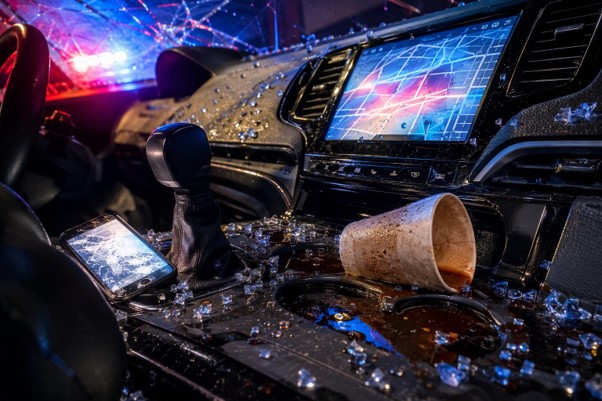
Seconds before impact, the other driver’s phone log shows a burst of activity. That detail looks damaging until dashcam footage reveals a different vehicle entering the intersection against a red light. Figuring out how to prove distracted driving in Illinois means separating what one piece of evidence shows from what a negligence claim actually requires.
The framework here is current as of 2026 and covers the full evidentiary chain an Illinois claimant must satisfy, starting with the conduct itself and ending with the damages to document. A phone record rarely resolves the question on its own.
To prove another driver was distracted in an Illinois crash, you need evidence showing what the driver was doing, when the conduct occurred, and how it contributed to the impact. Phone records can establish timing, but video, witness accounts, vehicle data, and physical crash evidence may be needed to prove fault.
How to Prove Distracted Driving in an Illinois Crash
A distraction must connect to the elements of negligence
Under Illinois law, a negligence claim generally has three elements (duty, breach of that duty, and an injury proximately caused by the breach), and Marshall v. Burger King Corp., 222 Ill. 2d 422, 430 (2006), recites this standard. Duty means every driver must exercise reasonable care under the circumstances. Breach is a failure to meet that standard, whether through illegal handheld phone use or another unsafe diversion of attention. Causation has two parts: cause in fact, meaning the breach actually contributed to the collision, and legal cause, meaning the collision was a reasonably foreseeable result of the breach. Damages cover the legally recognized harm the claimant suffered.
Evidence of distraction speaks to breach most directly. It says nothing on its own about whether the distraction caused the crash or what the crash cost the injured person. That gap matters. It is where claims involving distracted driving in Illinois are won or lost: texting may support the breach, but the claimant still has to connect that conduct to the crash and then document the resulting loss.
Illinois law restricts handheld electronic-device use
Illinois distracted-driving law adds a specific traffic offense to the general negligence framework. Under 625 ILCS 5/12-610.2, a driver generally may not operate a motor vehicle on an Illinois roadway while using an electronic communication device. The statute contains exceptions, including certain hands-free use and use of equipment physically integrated into the vehicle, and the current text controls what counts as a violation.
Not every interaction with a navigation screen breaks the law. A factory-installed system used in a permitted manner may fall outside the prohibition, so the charging language and current statute must be read together.
A statutory violation feeds the civil claim without deciding it. Under Kalata v. Anheuser-Busch, Inc., 144 Ill. 2d 425, 434 (1991), breaching a safety statute can supply prima facie evidence of negligence when the claimant belongs to the class the statute protects and the harm is the type the statute was designed to prevent. Prima facie evidence is rebuttable. It doesn’t automatically settle liability.
A traffic citation and a civil claim answer different questions
A police officer at the scene decides whether sufficient grounds exist for enforcement under the Illinois Vehicle Code. A civil negligence claim asks a different question: who bears responsibility for the injury. It proceeds under a different burden of proof and procedural framework.
A citation does not establish civil fault by itself. Depending on the circumstances and applicable evidence rules, an officer’s observations, a driver’s admission, or a guilty plea may be relevant. The absence of a citation also does not stop a claimant from presenting phone records, video, or witness testimony.
What Evidence Can Establish Distraction?
Phone and carrier records
How phone records prove distracted driving is mostly a question of timing. A carrier log may establish that a call, text transmission, or data session occurred near the moment of impact, which is distinct from the content stored on the device itself.
The limits deserve equal attention. A carrier timestamp may need to be synchronized with the crash report, a camera’s clock, or an emergency-dispatch log before anyone can determine whether the activity and impact occurred at the same time. A record may not reveal who physically handled the phone, since data traffic can occur automatically in the background, and encrypted message content may be unavailable. Evidence of texting while driving in Illinois still must connect a person’s phone use to the failure to brake, yield, or hold a lane that produced the impact.
Device data, app logs, and forensic extraction
A preserved device may hold notification logs and message timestamps alongside records of navigation inputs or application use. You can’t inspect another person’s phone without consent or lawful authority, and a claimant should never try.
Access may occur through Illinois discovery. Illinois Supreme Court Rule 201 governs the scope and proportionality of discovery, while Rule 214 governs requests to produce documents and tangible things. A request is not a guarantee. Relevance, scope, privacy, and preservation disputes determine what a court will actually order.
Video and witness observations
A dashcam can show a driver glancing downward. A storefront camera can capture a phone in a driver’s hand. Traffic video may reveal delayed braking or lane drift, and it can establish the sequence of events at an intersection.
Witnesses bring their own limits. A bystander’s credibility matters, as do the vantage point and timing of the observation. Illinois Rules of Evidence 401 and 901 address relevance and authentication, so footage and testimony must be connected to the crash they purport to describe.
Vehicle and physical crash evidence
Event-data-recorder output may capture speed and braking. Skid marks, impact location, and roadway evidence can help reconstruct the vehicles’ paths. What any recorder captures varies by make and model, and many vehicle systems do not log every driver input.
Reconstruction matters most when phone activity is undisputed but causation is contested. If the physical evidence shows timely braking and a controlled lane, the digital record may tell a more complicated story.
Admissions, social posts, and statements after impact
What a driver says to an officer, witness, or insurer can carry weight, and statements made at the scene may become important evidence. Screenshots and social posts require authentication and context because a post’s timing can be ambiguous.
| Evidence | What it may establish | What it usually cannot establish alone |
| Carrier records | Call, message, or data timing | Who handled the phone or why the crash occurred |
| Device or app data | Screen activity, inputs, or application use | Complete crash causation without corroboration |
| Video footage | Driver conduct and vehicle movement | Unrecorded phone content |
| Witness testimony | Visible conduct before impact | Precise digital timing unless independently documented |
| Vehicle data | Speed, braking, or other recorded inputs | The reason for the driver’s inattention |
| Physical crash evidence | Impact sequence and vehicle paths | The specific source of distraction |
Similar Distractions Can Produce Different Legal Outcomes
“Distracted driving” is a label, not a verdict. Each hypothetical below shows how the same category of conduct can lead to a different result.
Texting shortly before a rear-end collision
Consider a hypothetical. A driver sends a text seconds before striking traffic stopped at a red light, and the carrier data align with dashcam footage showing no braking until impact. Here, the combined proof supports distraction, timing, and causation far more strongly than the phone record alone.
The electronic-device statute supports the breach argument, and the absence of braking supports the causation argument. Reasonable care under Illinois law includes watching the road ahead, and stopped traffic at a red light is exactly what an attentive driver should have seen.
Entering a destination into navigation
Shift the facts. A driver enters an address while moving, but another motorist abruptly turns across the driver’s lawful path. The navigation entry may support a breach argument depending on how the system was used and whether it fell within a statutory exception.
Liability still depends on whether timely attention would have prevented the crash. The other motorist’s unsafe turn may carry decisive weight. A distracted driver does not automatically bear all fault.
Eating while driving
Eating while driving can count as a distraction. No general Illinois motor vehicle statute expressly prohibits eating while driving, but common-law negligence covers unsafe conduct the electronic-device statute never mentions.
Picture a driver whose sandwich spills mid-bite. The vehicle drifts across the centerline, and the skid marks show a late correction. Liability depends on whether the eating interfered with reasonable control or observation and whether that lapse contributed to the collision, and the physical evidence can help establish the claim.
Passengers and in-vehicle controls
Talking to a passenger is not automatically negligent. Liability becomes more plausible when the interaction causes the driver to turn away, lose control, or ignore a visible hazard.
Climate controls and integrated touchscreens deserve the same treatment. Legality and reasonable care are separate inquiries, and a lawful action can still be negligent under particular circumstances.
Why Causation Matters More Than the Label “Distracted”
Distraction without causation does not establish crash liability
Take a hypothetical driver who is using a phone while stopped and is then struck by a vehicle that crosses the centerline. The phone use may violate a traffic rule and still draw a separate penalty, yet it did not cause the oncoming vehicle’s movement. Cause in fact asks whether the harm would have occurred without the breach. Legal cause asks whether the collision was a reasonably foreseeable result of it. Illinois proximate-cause doctrine requires both.
Damages must also connect to the collision
A claimant must also prove that they suffered an injury or loss. Medical records show the injury and the treatment. Repair estimates and photographs prove property damage; employment records document lost income.
Keep the inquiries separate. Proving that you were hurt is not the same as proving who caused the crash, and a claim needs both. The damages evidence shows what the collision cost; the fault evidence addresses why the defendant may be legally responsible.
Other Driving Errors Can Overlap With Distraction
Speeding can change both causation and severity
A distracted driver may also be traveling above the posted limit or too fast for conditions, conduct addressed by 625 ILCS 5/11-601 and related provisions. Speed compresses reaction time, so a driver who looks up late has less room to correct.
Speed can also increase the severity of an impact. Two unsafe behaviors do not double liability. They give the fact-finder additional conduct to weigh within a single negligence analysis.
Impairment and distraction may require different proof
Apparent inattention may trace to phone use, fatigue, or impairment, and the relevant evidence differs. Toxicology results and officer observations address questions that device records do not. Legal conclusions about impairment must be evaluated under the Illinois DUI provisions at 625 ILCS 5/11-501 and the specific facts, not assumptions about a driver’s demeanor at the scene.
Failure to yield may remain the decisive act
Intersection crashes often layer phone use on top of a right-of-way violation. Signal timing, sightlines, and vehicle paths may determine which conduct actually produced the impact.
These errors often overlap. A single Chicago crash can involve several, and a court considers them together rather than in isolation when assigning fault.
Comparative Fault Can Reduce or Defeat Recovery
Illinois uses modified comparative negligence
Under 735 ILCS 5/2-1116, a claimant whose contributory fault exceeds 50 percent of the proximate cause of the injury is barred from recovery, while a claimant whose fault does not exceed 50 percent may recover damages reduced in proportion to the assigned fault.
A simple example shows the arithmetic. A claimant with $100,000 in proven damages who is assigned 20 percent fault would recover $80,000, subject to other legal and insurance issues. The threshold comes from the statute, not negotiation.
The injured person’s own conduct may be examined
Expect the other side to examine the claimant’s conduct. An insurer may argue that the claimant was speeding or following too closely when the impact occurred. It may also claim that the claimant ignored a signal or was using a phone.
Distraction by the other driver does not prevent a comparative-fault allocation when the claimant also contributed to the impact. The same evidence rules apply to both sides.
Evidence must be evaluated as a complete timeline
Synchronized sources can change the story. A phone timestamp, traffic video, and a braking record may point in one direction when read together and in three directions when read alone. Build the timeline before arguing the percentages.
Illinois Phone Tickets Are Separate From Civil Fault
How can police establish texting or handheld phone use?
An officer may rely on firsthand observation, an admission by the driver, video, or other admissible evidence. Searching the phone itself requires police to navigate separate consent, warrant, and evidentiary rules.
The prosecution must prove the charged violation under the applicable burden. A civil case proceeds under a different burden and may involve different evidence.
What does an Illinois phone ticket cost?
As of 2026, the fine schedule in 625 ILCS 5/12-610.2 rises with repeat violations. A first offense carries a maximum fine of $75, a second carries a $100 fine, a third carries a $125 fine, and a fourth or subsequent offense carries a $150 fine.
Court costs may be added to the fine. Insurance consequences and enhanced offenses involving injury or death require separate analysis under the statute. Verify the current statutory text and court information before relying on a total payable amount.
What grounds can be raised against a cell phone ticket?
A lawful defense examines the citation and supporting evidence. Illinois law permits cell-phone use while driving in specified situations, including emergencies, parking on the shoulder, certain traffic obstructions, and hands-free or voice-operated use.
No defense is guaranteed. Review the charging language against the current statute and consult an Illinois traffic lawyer before deciding how to respond.
Does dismissal of the ticket resolve the injury claim?
No. A dismissal may result from proof problems, procedural defects, or prosecutorial discretion, none of which independently determines civil negligence.
A dismissed ticket is not a verdict on fault.
An injured claimant may still rely on independently admissible evidence, including records and testimony the prosecution did not present.
Preserving Evidence Before It Disappears
- Record the scene, vehicle positions, and visible damage when it is safe to do so.
- Obtain the crash-report information and witness contact details.
- Identify nearby cameras quickly because footage may be overwritten.
- Preserve your own device, photographs, and communications without deleting or altering data.
- Send properly framed preservation requests when another party may hold relevant records.
- Use Illinois discovery procedures to seek private records through lawful channels if a claim proceeds.
Carriers, businesses, and vehicle systems retain data for different periods, so no universal retention deadline applies.
Fault Depends on the Full Evidentiary Chain
The label “distracted” starts the analysis; it does not finish it. A reliable Illinois claim connects what the driver was doing, when the driver did it, and how that conduct produced the specific collision, then documents the loss that followed.
Each source carries part of the evidentiary load; none necessarily carries it alone. The stronger claim is built on the complete chain.
The strongest Illinois distracted-driving case does not stop at proof that someone looked away. It shows what drew the driver’s attention, when control was lost, and how that lapse produced the specific collision.
About Lawyer Monthly
Lawyer Monthly delivers authoritative, accessible explainers on the intersection of law, culture, and life for legal professionals and an educated general audience.
Follow Lawyer Monthly
Follow Lawyer Monthly for continued coverage of negligence law, evidence and Illinois court developments.