
Florida has required Personal Injury Protection on registered passenger vehicles since the early 1970s, and the basic promise has stayed the same for decades. After a crash, each injured person turns first to their own policy for medical bills, regardless of who caused the collision. Lawmakers tried again to scrap the system in 2026, filing Senate Bill 522 and House Bill 769, and both bills died in committee when the session adjourned on March 13. So the no-fault framework remains in force, with the familiar $10,000 PIP requirement and $10,000 in property damage liability for most cars on the road.
What catches many people off guard is how unevenly that framework applies. A driver in a sedan and a rider on a motorcycle can be hit by the same careless driver at the same intersection and end up on completely different legal tracks. One has a pool of no-fault money and a list of strict deadlines attached to it. The other has no PIP at all, and the claim depends almost entirely on what coverage happens to exist somewhere else.
What PIP Actually Covers After a Car Crash
The starting point for car occupants is Section 627.736 of the Florida Statutes. People who sit down with a car accident lawyer new port richey residents have used for a minor fender bender are often surprised to hear how limited the benefit is in practice. PIP pays 80 percent of reasonable medical expenses and a portion of lost income, up to the $10,000 limit, plus a separate $5,000 death benefit. The remaining 20 percent of medical bills falls to the injured person, their health insurance, or optional medical payments coverage if they bought it.
The policy covers the named insured and relatives living in the same household, along with certain passengers who have no PIP of their own. It pays out even when the policyholder was the one who ran the red light. That fault-blind design is the whole point of the system, because it was meant to move small injury claims out of the courts and get bills paid quickly.
The 14-Day Window and the Emergency Medical Condition Finding
Two rules shape almost every PIP claim. The first requires the injured person to receive initial treatment within 14 days of the crash. Care from a hospital, an emergency room, a physician, a chiropractor, or a dentist can satisfy that requirement, and missing the window can eliminate PIP benefits for that injury entirely. Plenty of people feel sore but functional after a collision and decide to wait, only to discover later that the delay closed the door on coverage they had been paying for.
The second rule ties the size of the benefit to a medical finding. To access the full $10,000, a physician, osteopath, dentist, physician assistant, or advanced practice registered nurse must determine that the person had an emergency medical condition. Without that determination, benefits stop at $2,500. Chiropractors can provide the initial care, but they cannot make the emergency medical condition finding themselves, which is a detail that trips up a surprising number of claims. Massage therapy and acupuncture are also excluded from PIP reimbursement under the current statute.
The Tort Threshold and Claims Beyond PIP
Since PIP covers only part of the losses, the next question is when an injured driver can pursue the person who caused the crash. Section 627.737 sets a threshold. A car occupant can recover damages for pain and suffering from the at-fault driver only if the injury meets one of the statutory categories, which include significant and permanent loss of an important bodily function, permanent injury within a reasonable degree of medical probability, significant and permanent scarring or disfigurement, and death.
Medical records do much of the work at this stage. A treating doctor’s opinion on permanency often decides whether a case stays inside the no-fault system or moves into a negligence claim against the other driver’s bodily injury coverage. Funny thing is, Florida does not require most drivers to carry bodily injury liability coverage in the first place. Proof of PIP and property damage liability is enough to register a car, so a successful claim against an at-fault driver can still run into an empty policy.
Why Motorcycles Sit Outside the No-Fault System
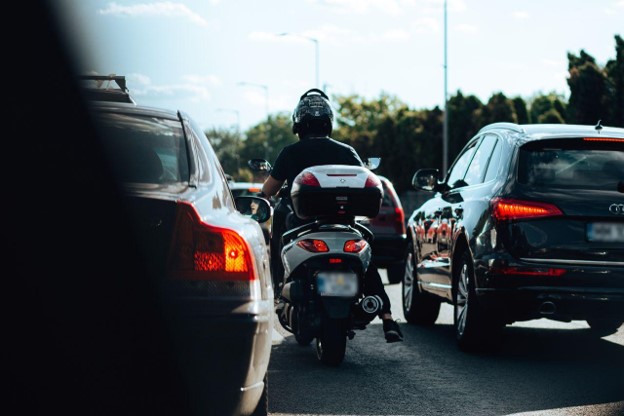
The definition of “motor vehicle” in the no-fault statute excludes motorcycles and mopeds. That single drafting choice has a long chain of consequences. Riders are not required to buy PIP to register a bike, and an existing PIP policy on a rider’s car generally does not follow them onto the motorcycle. In a collision with a car, the rider is typically outside both the protection and the restrictions of the no-fault law.
Many riders first learn this after a crash, when medical bills arrive and there is no automatic $10,000 to absorb them. Attorneys at firms with Pasco County locations, such as the office listed at https://www.zervosinjurylaw.com/wesley-chapel, commonly start these conversations by sorting out which policies exist at all, because the answer varies widely from one household to the next.
Helmets, Medical Coverage, and the $10,000 Figure
The same $10,000 number shows up in a different place for riders. Under Section 316.211, a motorcyclist who is over 21 may ride without a helmet only if they carry an insurance policy providing at least $10,000 in medical benefits for crash injuries. Eye protection is required either way. In practice, enforcement of the insurance part of that rule is light, and plenty of helmetless riders have no such policy. When a crash happens, the absence of coverage becomes a very real financial problem for the rider and the rider’s family.
Riders do have optional tools. Medical payments coverage can be added to a motorcycle policy, and uninsured motorist coverage can be purchased alongside bodily injury liability. Health insurance also fills part of the gap, though it typically asserts a right to be repaid from any later settlement. Each of these pieces has its own rules, and none of them work the way PIP does.
How a Rider’s Injury Claim Actually Proceeds
Since riders fall outside the no-fault framework, the permanency threshold that limits pain and suffering claims for car occupants generally does not restrict them in the same way. A rider hit by a negligent driver can usually pursue the full range of damages, including medical costs, income loss, and non-economic harm, directly against the driver who caused the crash. On paper, that is a broader right than a car occupant has.
Here’s the kicker though. A broad right is worth only as much as the coverage behind it. If the driver who turned left across the rider’s path carries no bodily injury liability, the claim may have nowhere to go unless the rider bought uninsured motorist coverage. Someone weighing these options with a wesley chapel motorcycle accident lawyer will usually hear an early assessment of three things: the other driver’s policies, the rider’s own optional coverages, and any household policies that might extend to the rider. That inventory often matters more to the final outcome than the details of the collision itself.
Comparative fault also enters the picture. Since the 2023 changes to Florida negligence law, an injured person found more than 50 percent responsible for their own injuries recovers nothing from the other party. For riders, insurers sometimes argue that speed, lane position, or visibility contributed to the crash. Those arguments affect the percentage assigned to each side, which in turn shapes how much of the available coverage the rider can reach.
A System Built Around Four Wheels
Florida’s no-fault law was written with cars in mind, and it shows. Drivers get a modest, fast benefit wrapped in strict timelines, followed by a threshold they must clear before suing. Riders get none of the fast money and none of the threshold, which leaves them free to pursue a full claim and fully exposed to whatever coverage gaps exist on the other side. Anyone who spends time on both two wheels and four in Florida ends up living under two very different sets of rules, often without realizing it until the day those rules suddenly matter.