
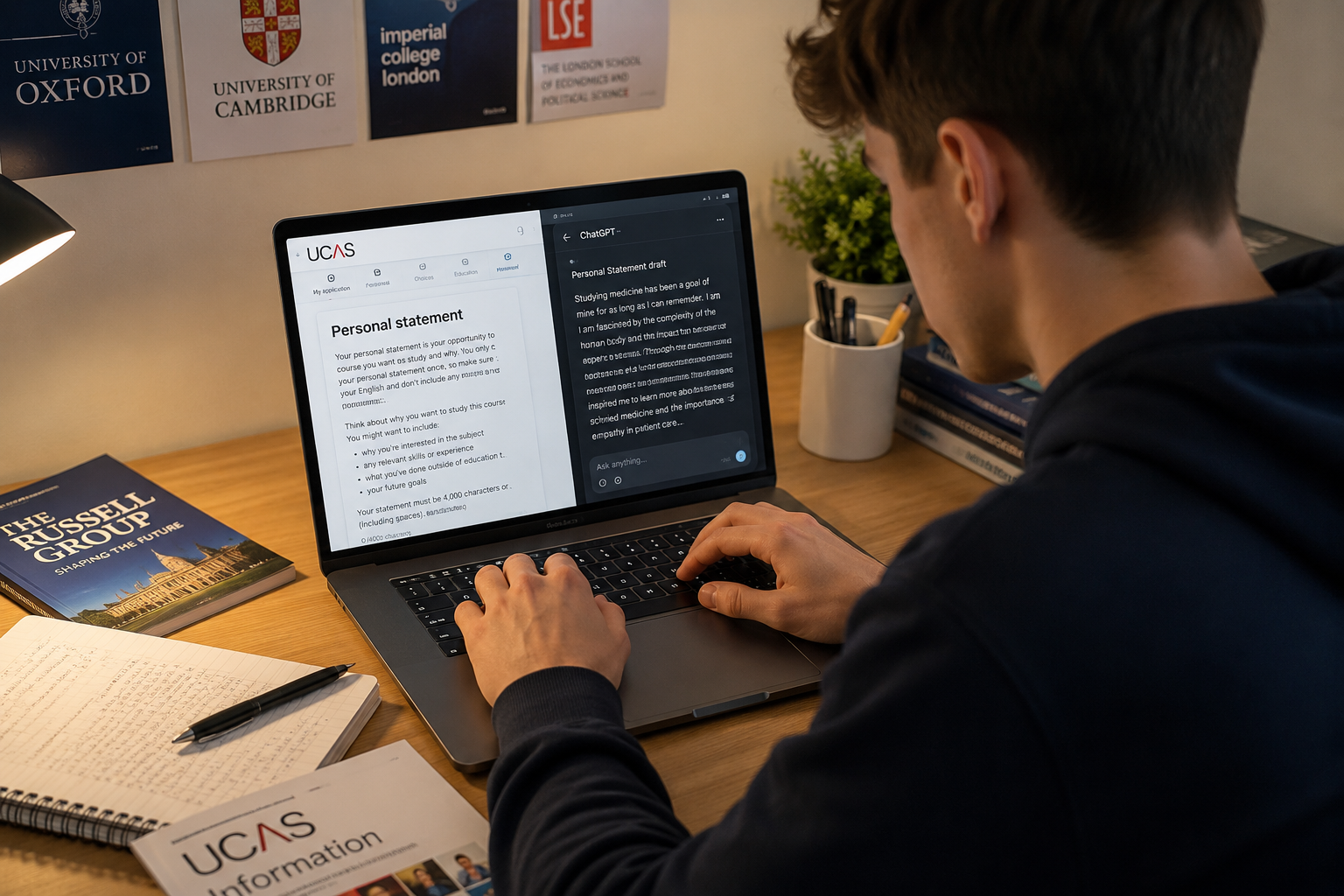
Applications for the 2027 UCAS cycle are opening amid growing concern over AI-written personal statements after UCAS warned that applications containing copied AI-generated material could be treated as fraud or cheating by universities and colleges.
Students can now begin preparing applications ahead of formal submissions opening later this year. But alongside the usual competition for Oxbridge, medicine and top Russell Group places, universities are entering an admissions environment increasingly shaped by generative AI tools, authenticity checks and mounting concerns over whether traditional application systems can still reliably distinguish genuine student work from AI-assisted submissions.
UCAS has warned applicants that copying and submitting substantial AI-generated text as part of a personal statement may jeopardise university offers, while applicants are now required to declare that personal statements have not been copied from another source, including artificial intelligence software.
The organisation also says its verification systems monitor patterns of similarity across applications and may notify universities where suspicious similarities are identified, increasing pressure on applicants, schools and admissions advisers to ensure personal statements remain genuinely individual.
The shift is transforming what was once viewed primarily as a routine admissions process into a broader governance, reputational and procedural risk issue for universities, schools and applicants attempting to navigate rapidly evolving expectations around authenticity, fairness and application integrity.
Universities Are Entering a Legally Sensitive Admissions Grey Zone
One of the biggest problems facing universities is that generative AI has blurred the line between legitimate assistance and potentially misleading authorship.
Students can now use tools such as ChatGPT, Grammarly, Microsoft Copilot and other AI systems to brainstorm ideas, restructure sentences, improve readability and draft large sections of application material within seconds.
Even UCAS itself acknowledges that universities and colleges understand AI tools can be useful when used appropriately. But the organisation simultaneously warns that overreliance on AI-generated content may harm a student’s chances of receiving an offer if applications appear inauthentic or trigger fraud concerns. That contradiction is becoming increasingly difficult for admissions teams to manage consistently.
Universities are unlikely to prohibit AI-assisted preparation entirely because AI tools are already becoming embedded within education and professional life. Instead, institutions are drifting into a more uncertain middle ground where limited AI assistance may be tolerated while authenticity concerns are subjected to greater scrutiny.
For applicants, that creates growing uncertainty around where universities draw the line between acceptable support and misleading representation.
For universities, the risk is different. Institutions that reject applicants based on suspected AI misuse could face complaints or criticism if applicants believe admissions decisions were inconsistent or lacked transparency.
Schools and Advisers Are Facing Growing Pressure Over Student Guidance
The rapid expansion of AI-assisted university applications is also creating a more exposed advisory environment for schools, private admissions consultants and careers advisers responsible for guiding students through increasingly competitive admissions processes.
In many independent and high-performing schools, Oxbridge placements, medicine admissions success rates and Russell Group acceptance figures form part of broader recruitment positioning and parental expectations. Families are also investing heavily in admissions coaching, interview preparation and application support services, increasing pressure on schools and advisers to provide reliable guidance around acceptable AI usage.
That challenge is becoming more complicated because fully standardised sector-wide rules around AI-assisted applications still do not exist.
Some schools and colleges have already begun issuing guidance on AI-assisted coursework and personal statement preparation as concerns grow over authenticity, admissions integrity and application verification. But the boundaries remain difficult to define consistently in practice.
A student using AI tools to improve grammar or restructure sentences may be treated very differently from a student generating substantial sections of application material through generative AI systems. As those tools become more sophisticated, however, distinguishing between editing assistance and substantive authorship is becoming increasingly difficult for schools, advisers and admissions teams alike.
That uncertainty is creating growing operational and reputational pressure across the admissions process. Universities may face disputes over application authenticity, while schools and advisers could face criticism from families if students later believe guidance around AI-assisted applications was unclear, inconsistent or insufficiently cautious.
Oxbridge and Medicine Admissions Could Face Even Greater Scrutiny
Applications to University of Oxford, University of Cambridge, medicine, dentistry and veterinary science courses are already subject to heightened scrutiny because of limited places and additional admissions requirements.
The October 15 application deadline for many of these courses means students often begin preparing months earlier than standard applicants, including undertaking admissions tests, interviews and wider reading programmes. That pressure is now colliding directly with the rapid expansion of AI-assisted preparation tools.
Some universities may increasingly place greater emphasis on interviews, admissions testing and live assessment exercises precisely because written application materials are becoming harder to authenticate confidently.
That may contribute to a broader shift across highly competitive university admissions over the next several years, particularly if institutions begin viewing traditional written submissions as less reliable indicators of individual student ability.
The consequence may be a gradual rebalancing away from polished written applications and toward assessment methods considered harder to manipulate using AI systems.
Why the Legal and Procedural Risks Are Growing
The central question emerging from the 2027 admissions cycle is becoming increasingly difficult for universities to avoid:
How should institutions assess fairness and authenticity in an admissions system where AI-assisted applications are rapidly becoming normalised?
That question now sits at the centre of a broader institutional challenge facing higher education admissions. Universities are being forced to balance admissions integrity against growing scrutiny around transparency, consistency and equal treatment between applicants at a time when AI-assisted preparation tools are becoming increasingly common.
The issue extends beyond personal statements alone. It overlaps with wider concerns already shaping university admissions, including how institutions review applications consistently, how complaints and appeals are handled, how applicant information is verified, and whether unequal access to private coaching or AI-assisted support could widen existing participation gaps between applicants.
The pressure is unlikely to ease. Generative AI systems are evolving far faster than many admissions frameworks were originally designed to accommodate, creating operational uncertainty for universities attempting to preserve confidence in their admissions processes while avoiding accusations of unfairness or inconsistency.
That leaves institutions exposed whichever direction they take. Universities perceived as too permissive may face criticism over admissions credibility and verification standards. But institutions that aggressively scrutinise AI-assisted applications without clear procedures or transparent guidance risk generating complaints, reputational pressure and growing concerns around procedural fairness.
Why the 2027 UCAS Cycle Feels Fundamentally Different
The 2027 UCAS cycle is unfolding at a moment when generative AI is rapidly changing how university applications are researched, drafted and assessed across the education sector.
Unlike previous admissions cycles, universities are now being forced to evaluate applications in an environment where AI-assisted writing tools have become mainstream before clear sector-wide standards around acceptable usage, authenticity and verification have fully developed.
That shift is creating growing pressure on traditional admissions systems, particularly around how institutions distinguish genuine student work from heavily AI-assisted submissions while still maintaining fairness and consistency across applicants.
For universities, the challenge is no longer limited to selecting the strongest candidates. Institutions must also protect the credibility of admissions processes without creating accusations of inconsistency, opaque decision-making or unfair treatment.
For schools and advisers, the pressure is becoming increasingly operational. Guidance given to students around AI usage, personal statement preparation and admissions support may face greater scrutiny as universities strengthen verification procedures and application integrity checks.
And for applicants, uncertainty is expanding beyond competition for places alone. Students are now entering an admissions environment where expectations around authenticity, acceptable AI assistance and application integrity are evolving faster than many formal admissions frameworks were originally designed to handle.