
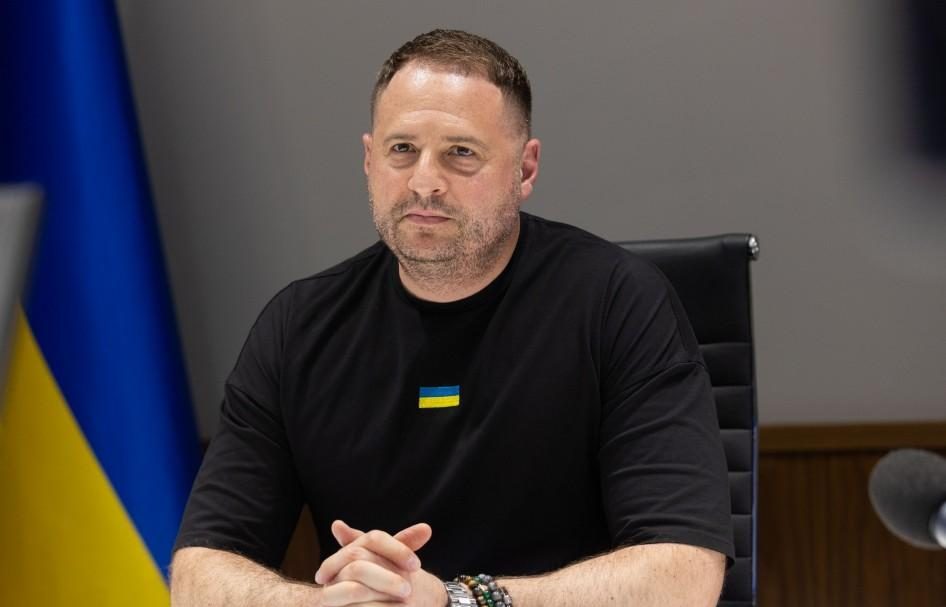
Ukraine’s anti-corruption crackdown has reached deeper into President Volodymyr Zelensky’s inner circle after former chief of staff Andriy Yermak was taken into custody on money-laundering charges linked to the alleged laundering of $10.5 million through a luxury Kyiv housing development.
The arrest places new pressure on Zelensky’s presidential administration at a moment when Ukraine is trying to maintain Western support, protect public confidence and prove that senior wartime officials can still face independent anti-corruption enforcement.
Ukrainian anti-corruption agencies allege Yermak participated in a criminal group that laundered around $10.5 million through an elite residential project near Kyiv. The wider investigation forms part of “Operation Midas,” a major corruption probe tied to alleged kickback schemes in Ukraine’s energy sector.
Yermak has denied wrongdoing and said his legal team will appeal after Ukraine’s anti-corruption court set bail at 140 million hryvnias, roughly $3.2 million.
His arrest escalates political pressure around the presidential administration because Yermak was widely viewed as the second most influential figure in Ukraine before resigning during a government reshuffle last year aimed at restoring trust in the president’s office. His influence extended across negotiations, political appointments and wartime strategy despite his unelected role.
For Ukrainians already living with the cost of war, the case feeds anger over whether emergency wartime governance has allowed too much power to gather around a small presidential circle while anti-corruption agencies attempt to prove that senior insiders are still within reach.
The allegations also land at a sensitive moment for Kyiv’s relationship with Europe. Ukraine’s push to join the European Union depends heavily on showing credible rule-of-law institutions, independent courts and anti-corruption enforcement that can operate even when politically connected figures are involved.
International lenders, reconstruction partners and European governments will be watching how the case develops because corruption enforcement involving senior officials affects confidence in Ukraine’s public procurement, post-war rebuilding plans and long-term governance.
Operation Midas already carried political weight because authorities have linked it to former Zelensky associate Timur Mindich, who is accused of leading a $100 million kickback scheme in the energy sector. Mindich has denied wrongdoing and is believed to be in Israel.
Another former senior official, Oleksiy Chernyshov, has also faced allegations tied to related investigations and has denied wrongdoing.
Zelensky himself does not face immediate legal exposure from the Yermak case because Ukrainian law shields sitting presidents from prosecution while in office. The political danger lies elsewhere: repeated allegations involving senior allies could damage perceptions of how power has operated inside Ukraine’s wartime leadership.
Ukraine has spent years presenting anti-corruption reform as central to its democratic future and EU ambitions. Cases involving senior insiders draw heavier attention because they test whether enforcement bodies can pursue politically sensitive figures without being blocked, delayed or weakened.
The controversy intensified after Ukrainian media outlets and opposition lawmakers circulated purported leaked wiretap transcripts allegedly involving discussions about the Kyiv property development. The recordings have not been independently verified, and no evidence has publicly implicated Zelensky.
The investigation has already fuelled criticism from opposition politicians who argue that wartime governance has concentrated excessive influence inside a small presidential circle built around loyalty to Zelensky.
Opposition lawmaker Iryna Herashchenko criticised what she described as an unwillingness to broaden the circle of candidates and rely on experienced professionals during wartime.
For outside governments and institutions backing Ukraine, the Yermak case will be read as a test of whether anti-corruption bodies can reach into the highest levels of political influence during war. A strong, transparent process could help Kyiv defend its reform record. A weak or selective process would hand critics an argument that Ukraine’s anti-corruption promises still depend too heavily on politics.
Ukraine continues relying on Western financial and military backing while preparing for eventual reconstruction. That makes corruption investigations involving once-powerful figures more than domestic political drama; they become part of the confidence test facing Ukraine’s wartime state.