
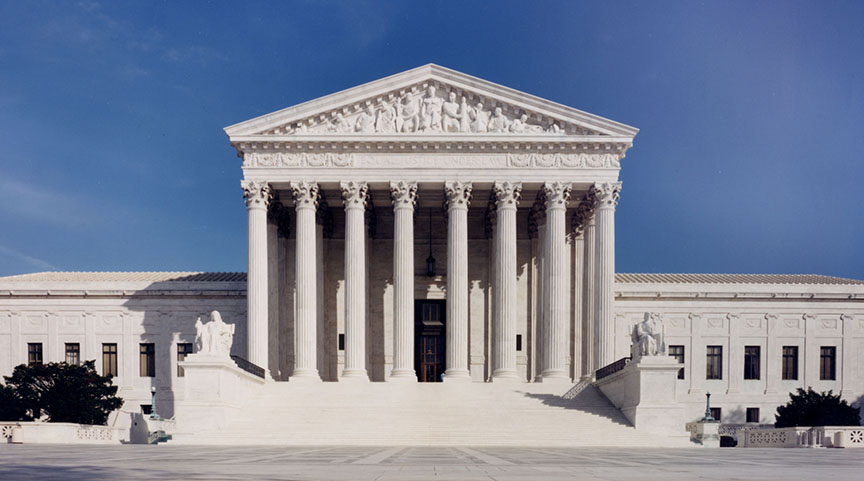
The U.S. Supreme Court has struck down federal limits on coordinated spending between political parties and their candidates, ruling 6-3 that the restriction violates the First Amendment.
Tuesday’s decision in National Republican Senatorial Committee v. Federal Election Commission overturns the court’s 2001 ruling in FEC v. Colorado Republican Federal Campaign Committee, which had upheld the same limits by a narrower 5-4 margin.
Justice Brett Kavanaugh, writing for the majority, held that the only constitutionally sound basis for campaign-finance restrictions is preventing quid pro quo corruption. He found that existing safeguards already address the concern that coordinated-spending limits were meant to guard against, pointing to base contribution limits, anti-earmarking rules and federal disclosure requirements.
The case originated in 2022, when then-Senator J.D. Vance, then-Representative Steve Chabot, and the National Republican Senatorial and Congressional Committees challenged the coordinated-expenditure limits in federal court in Cincinnati.
The full U.S. Court of Appeals for the 6th Circuit, in an opinion by Chief Judge Jeffrey Sutton, upheld the restrictions as bound by the 2001 precedent despite what Sutton called the challengers’ fair points. With the current administration declining to defend the statute, the Supreme Court appointed Roman Martinez, a former clerk to Chief Justice John Roberts, to argue in its support.
Justice Elena Kagan dissented, joined by Justices Sonia Sotomayor and Ketanji Brown Jackson, warning that the ruling reopens a route for donors to route far larger sums to candidates through party committees than direct contribution limits would otherwise permit.
Kagan’s dissent notes that a donor could now give a party up to half a million dollars to cover a candidate’s expenses, compared with the $7,000 cap on what that donor could give the candidate directly.
The ruling reshapes how party committees and candidate campaigns can structure joint advertising and spending arrangements ahead of the next federal election cycle.
Compliance teams advising political committees will need to revisit guidance built around the now-defunct 2001 framework, particularly around what counts as permissible coordination versus prohibited earmarking, since the majority’s reasoning leaves the base contribution limits and disclosure rules as the primary remaining checks.
Election-law and campaign-finance practices should expect renewed client demand for guidance on structuring joint fundraising and coordinated expenditure agreements in light of the changed compliance baseline.