
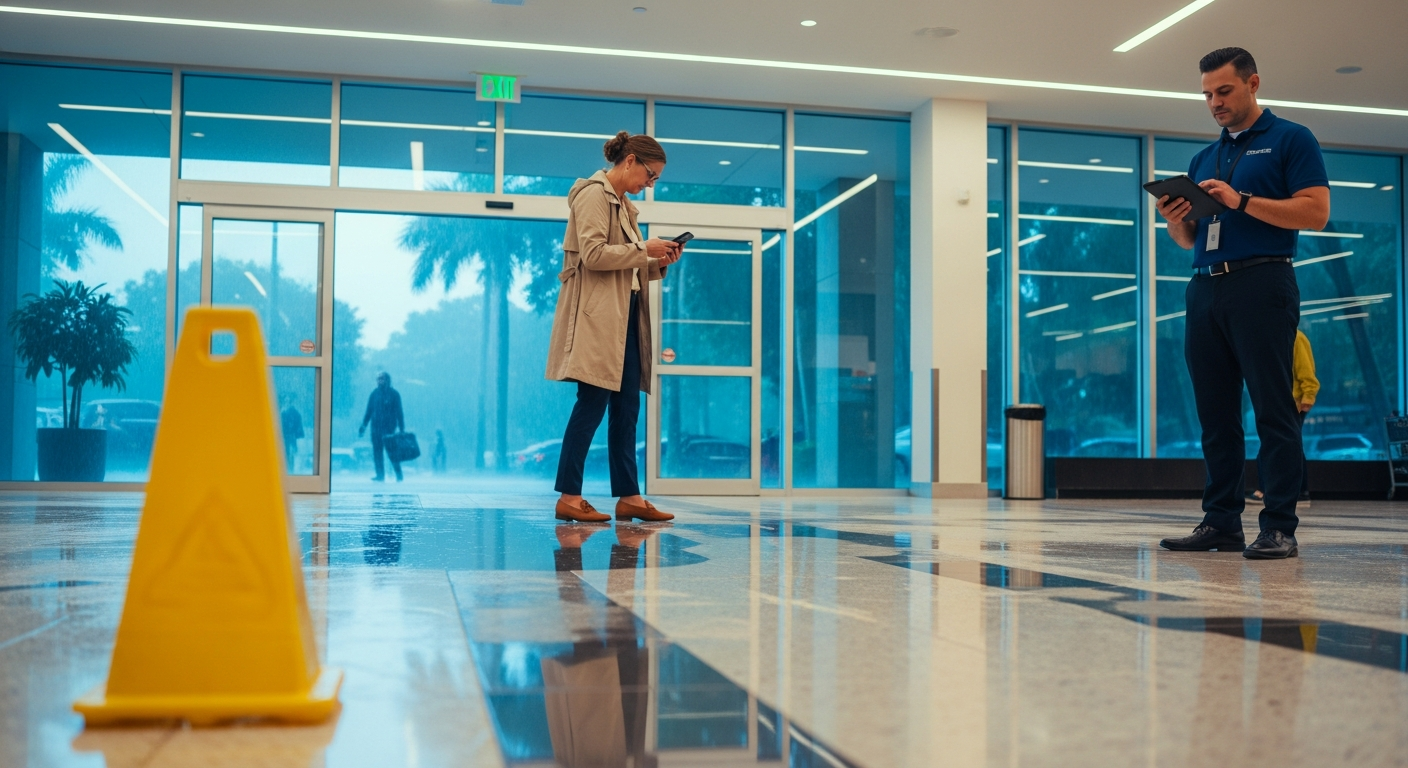
During South Florida’s rainy season, wet entryways and tracked-in water can turn an ordinary errand into a risk of injury. Shoppers regularly meet slick grocery vestibules, slippery hotel lobbies, and flooded retail walkways. Under Florida law, though, a wet floor by itself does not automatically make a business liable.
So is a business responsible just because you slipped on rainwater indoors? Usually not. The real question is whether the business knew, or should have known, that the condition was dangerous and then failed to fix it or warn customers. That standard keeps businesses from being strictly liable for every weather-related accident.
To win a claim, an injured person must demonstrate that the property manager or owner failed to exercise reasonable care. Under Florida Statute §768.0755, that means proving the business had proper notice of the hazard. Without proof of notice, a rainy-day fall is often treated as an accident rather than a compensable claim.
What Does Florida Law Actually Require?
What Is a “Transitory Foreign Substance”?
In legal terms, rainwater tracked into a store counts as a transitory foreign substance: a temporary hazard that does not permanently belong on the floor. Think spilled liquid, tracked-in rainwater, melted ice, or a surface someone just mopped.
That’s different from a permanent design defect or a structural hazard. A broken staircase, a collapsed roof, or uneven concrete is a permanent property issue. Because temporary hazards, such as rainwater, can appear and disappear quickly, the law applies a specific set of rules to determine fault.
Why Florida Statute §768.0755 Matters
In business-establishment slip-and-fall cases involving transitory foreign substances, the injured person has the burden of proof. According to Florida law, the claimant must prove the business knew or should have known about the dangerous condition. The business must also have failed to take appropriate action to remedy the issue.
A claimant can prove that knowledge through direct or circumstantial evidence. The statute reshaped Florida premises liability litigation by putting the emphasis squarely on notice. Instead of simply showing that a floor was wet, you have to reconstruct the timeline of how long it stayed wet.
When Can a Business Be Liable for a Rainy-Day Fall?
Actual Notice
Actual notice means the business plainly knew about the hazard before the fall. It’s the most direct route to liability, though it isn’t always easy to prove. A business has actual notice if an employee saw the puddle, or if another customer reported it to management.
Sometimes staff creates the hazard themselves. If workers left a slick surface during cleanup and walked off without posting a sign, that’s actual notice. Surveillance cameras and incident records often serve as the primary evidence of staff awareness.
Constructive Notice
Constructive notice applies when the business may not admit knowing about the water, but the circumstances say it should have known. That happens when the hazard existed long enough to be caught through reasonable inspections. Store owners are expected to check their floors routinely.
It can also apply when the dangerous condition happened with regularity and was foreseeable. If a specific entrance floods every afternoon during heavy rain, the business can’t claim ignorance. It may have constructive notice of a recurring weather-related danger and a duty to take ongoing precautions.
What Courts and Claims Often Look At
Courts look closely at whether the water sat long enough to be discovered. Physical evidence left at the scene usually tells the story. Footprints, cart tracks, dirt, streaking, or spreading water all suggest the condition was not brand new.
If you want more background on how Florida slip-and-fall laws apply to wet floors, tracked-in water, notice, and inspection practices, remember that these cases often turn on what the business knew and what it did in response. Claims adjusters will dig into whether rainy weather made recurring pooling near the entrance foreseeable.
Safety protocols carry a lot of weight too. Adjusters check whether staff was assigned to monitor the area during the storm. They may request inspection logs to see how consistent they are, and review whether mats, cones, and warning signs were deployed correctly.
| Issue | May Support Liability | May Weaken Liability |
|---|---|---|
| How long the water was present | Evidence it sat for a while (tracks, dirt) | No proof of duration; sudden spill |
| Prior reports or employee awareness | Staff knew or were previously told | No evidence anyone knew |
| Inspection practices | Gaps in inspections or poor daily logs | Recent, accurately documented inspection |
| Warning measures | No mats, no cones, no caution signs | Clear warning signs and large floor mats |
| Recurring rainy-day problem | Same entrance often gets slick | Isolated, unexpected condition |
| Video/photos | Show puddle was visible and ignored | No footage or unclear evidence |
When a Wet Floor May Not Be Enough
Rain on its own doesn’t make a business negligent, because owners aren’t absolute insurers of customer safety. You still have to prove the business failed to use reasonable care. If a customer shakes an umbrella and leaves a puddle seconds before someone else slips, the business likely didn’t have time to discover it.
A warning sign can help the defense, but it doesn’t automatically end a claim. A single cone placed badly near a large puddle may still be deemed insufficient. Clear warnings and heavy-duty floor mats, on the other hand, show the business tried to reduce the risk.
Florida also runs on a comparative fault framework. If a hazard was open and obvious, a court may decide the injured person was partly responsible for not watching their step. And if that person is found to bear most of the blame, it can sharply reduce or even bar financial recovery.
What Evidence Usually Matters Most After a Rainy-Day Fall?
The Most Useful Evidence
The outcome of a premises liability claim often comes down to how fast the evidence is preserved. Without concrete proof of the conditions at the exact moment of the fall, proving the claim gets much harder. Gathering the right documentation right away can make a real difference. Here’s what tends to matter most:
- Photos or video of the water, floor mats, warning signs, and overhead lighting.
- The specific time and location of the fall within the store.
- Names and contact details of employees and bystander witnesses.
- The official incident report made to management before leaving the property.
- Formal requests to preserve interior surveillance footage.
- Store inspection and daily employee cleaning logs.
- The exact shoes and clothing worn that day.
- Medical records showing prompt treatment for the injuries.
Photos can capture the size of a puddle, a lack of mat coverage, or the absence of caution signs before staff cleans the area. Keeping the shoes you wore can rebut claims that bad footwear caused the slip. Prompt medical care ties your injury to the incident, and reporting the fall creates an immediate timestamp.
What Should Customers Do Right After a Slip and Fall?
Immediate Next Steps
Report the fall to staff or management immediately and ask for a copy of the incident report. If they refuse a copy, note the manager’s name and the report number. Take photos of the area before the condition changes, and make sure you capture any missing mats or warning signs. Get the contact information of witnesses to the fall or the puddle.
Seek medical care promptly, even if symptoms seem minor at first, because adrenaline can mask serious injuries. Keep the shoes and clothes you were wearing unwashed and stored somewhere safe. Finally, avoid guessing or exaggerating in written or recorded statements to insurers, since speculative comments can be used against you later.
Why Rainy Season Increases the Risk
South Florida’s frequent afternoon storms put tracked-in water and slick entrances back in the spotlight. Commercial properties with heavy foot traffic, including grocery stores, shopping centers, and retail outlets, tend to face more exposure when rainwater is constantly dragged indoors.
Solid maintenance and safety procedures are critical during these months to help prevent accidents. According to CDC fall data and research, falls remain a major cause of injury and emergency treatment. Businesses that leave entryways unchecked during a storm raise the odds of a preventable injury.
The reality of these accidents is serious. Falls remain a significant injury issue across the state, affecting thousands of residents and tourists each year. Businesses that fail to prepare for seasonal weather can add to that preventable count.
Quick FAQ
Is a business liable every time someone slips on rainwater?
No. The injured person usually has to prove the business knew or should have known about the hazard. The claimant also has to prove the business failed to respond reasonably by clearing the water or warning customers.
Do warning signs automatically protect the business?
Not always. Signs can help the defense, but courts may still weigh placement, timing, and visibility. If a puddle is large and a single sign is hidden behind a display, the business may still be held responsible.
What if I didn’t notice the puddle before I fell?
That doesn’t automatically defeat a claim. The facts still matter, including lighting, visibility, store distractions, and whether the business had notice. Comparative fault may apply, but failing to see clear water on a shiny floor is common.
The Bottom Line on Rainy-Day Slip-and-Fall Claims in Florida
A wet floor during a Florida rainstorm doesn’t guarantee a successful claim or settlement. Proving liability means showing the business had actual or constructive notice of the tracked-in water and failed to act appropriately. A wet floor by itself is usually not enough to secure compensation.
Gathering physical evidence quickly, reporting the incident to management, and understanding the specific requirements of Florida law are the steps that count. Anyone injured in a commercial establishment should act quickly to document the scene before the hazard is removed and the evidence disappears.