
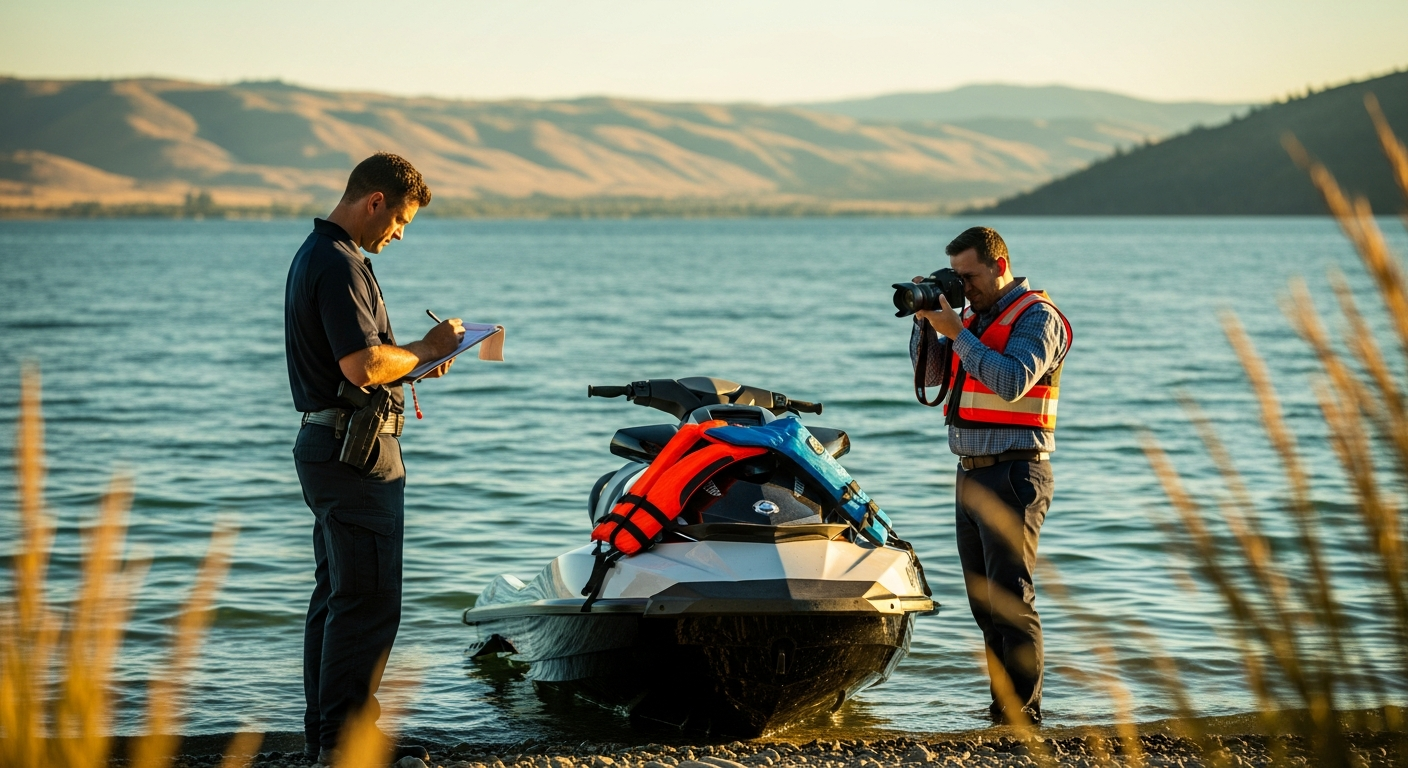
If you’ve been hurt on the water, you probably want a straight answer about who can sue after a Washington jet ski crash. More than one person may have that right, including injured passengers, jet ski riders, boat occupants, and sometimes the family of someone who died. The central question usually comes down to fault: whether a person or company failed to use reasonable care.
Jet ski crashes aren’t simple water mishaps. They raise the same liability questions you see in highway auto accident claims. A recent collision on Moses Lake involving a boat and a jet ski reportedly injured five people. One person was airlifted to Seattle, another was flown to Spokane, and three more were taken to Samaritan Healthcare. As the Grant County Sheriff’s Office investigates, the case underscores a hard reality: boating accidents often produce catastrophic injuries, overlapping insurance policies, and multiple injured claimants.
The real dispute in these claims is rarely whether someone got hurt. Instead, cases turn on who was at fault, what evidence exists, and what insurance or business coverage applies. Here’s how Washington law looks at watercraft liability.
Who Can Sue After a Washington Jet Ski Crash?
Washington law allows multiple parties to bring injury claims arising out of the same crash. The right to file depends on the claimant’s status and whether another party caused the incident.
Injured Passengers Can Often Bring Claims
Passengers on a boat or jet ski usually have no physical control over the craft. Because they’re just along for the ride, they rarely bear any fault for a collision. If a passenger is injured because an operator was speeding, distracted, intoxicated, or following too closely, that passenger may have a strong claim.
An injured passenger can sue the operator of the boat they were riding on, the operator of the other vessel, or both. If multiple operators contributed to the crash, Washington courts allow the passenger to hold each at-fault party responsible for their share of the damages.
Boat Operators and Jet Ski Riders May Also Sue
Operating a vessel doesn’t bar you from filing a lawsuit. Boat operators and riders of a personal watercraft can sue another negligent operator who caused or contributed to the collision. That holds even if both operators made mistakes on the water.
The state follows a comparative fault system. Under this standard, a claimant’s damages are reduced by their own percentage of fault rather than automatically barred. So if a jury finds a jet ski rider 20 percent at fault and a speeding boat operator 80 percent at fault, the rider can still recover 80 percent of their total damages from the boat operator.
Families May Have Wrongful Death or Survival Claims
When a boating collision turns fatal, the deceased person can’t bring a lawsuit. Instead, Washington allows specific family members or the estate to file a wrongful death or survival claim. These claims offer a way to seek compensation for funeral costs, lost future income, medical bills incurred before death, and the loss of companionship.
State estate laws dictate exactly who has standing to file, typically the surviving spouse, registered domestic partner, or children. The right to sue depends on meeting those statutory requirements.
What Does Washington Negligence Law Look For?
To win a civil lawsuit, an injured party must prove that another person or business acted carelessly. In legal terms, this is called establishing fault.
Negligence Means Failing to Use Reasonable Care
Negligence means failing to act as a reasonably careful watercraft operator would under similar conditions. If an operator breaks a state boating safety rule or ignores an obvious hazard, they may have failed to use reasonable care. Liability attaches when that failure directly causes an injury.
Common Fault Issues in Jet Ski and Boat Collisions
Establishing fault means matching an operator’s actions to specific safety failures. The most frequent issues in Washington boating injury claims include:
- Speeding or operating too fast for conditions and visibility
- Following too closely behind another vessel
- Failing to keep a proper lookout for swimmers and other watercraft
- Distracted operation, such as looking at a phone or adjusting a radio
- Alcohol or drug impairment
- Inexperienced operation or lack of state-required safety training
- Unsafe turns or aggressively crossing another vessel’s wake
- Violating established right-of-way boating rules
Investigators look for these failures when they interview witnesses and map out the crash site. An operator making a sharp, unexpected turn across a busy channel can be as liable as a driver running a red light on a highway.
Alcohol, Distraction, and Medical Events Can Change the Case
Physical impairment and distraction can dramatically alter a claim. State traffic data shows that 135 fatalities in 2023 were attributed to distracted driving, and the same lack of focus can create deadly hazards on open water. Investigators will examine whether impairment, distraction, fatigue, or poor weather affected the operator.
Medical emergencies can also play a role. According to local reporting, early reports indicate an 18-year-old operator’s lifelong medical condition may have contributed to the recent Moses Lake collision. When an unexpected medical event occurs, investigators and lawyers must carefully untangle whether the operator knew the condition made operating unsafe.
Can a Rental Company Be Liable After a Jet Ski Crash?
Watercraft rentals are hugely popular across Washington lakes. When a rented jet ski is involved in a collision, injured parties often ask whether the business itself can be sued.
Rental Liability Is Possible, But It Depends on the Facts
A rental company isn’t automatically liable just because one of its jet skis was involved in a crash. To hold the business accountable, you need to prove it engaged in negligent business practices. A company may face exposure if it rented equipment to someone visibly intoxicated, failed to give required safety instructions, or handed over a poorly maintained, defective machine.
Evidence That May Support a Rental-Based Claim
Proving a business acted negligently often requires specific internal documents. Attorneys may rely on signed rental contracts, daily maintenance logs, mechanical inspection records, and employee training manuals. If a rental company ignored age restrictions or licensing requirements to make a quick sale, it may share the blame for the resulting harm.
| Potential Defendant | When They May Be Liable | Key Evidence Needed to Prove the Claim |
|---|---|---|
| Boat Operator | Careless or reckless operation directly caused the crash. | Sheriff report, witness statements, accident scene photos, toxicology results. |
| Jet Ski Rider | Unsafe riding, speeding, inattention, or boating rule violations. | Incident reconstruction, witness accounts, GoPro or dock video footage. |
| Rental Company | Negligent rental practices, poor maintenance, or inadequate safety instruction. | Rental file, maintenance logs, signed waivers, employee training records. |
| Owner of Vessel | Negligent entrustment to a dangerous operator or providing unsafe equipment. | Ownership records, repair records, lending history, knowledge of the operator’s habits. |
What Evidence Usually Decides a Washington Boating Injury Claim?
Water collisions wipe away physical evidence fast. Waves erase telltale signs, and damaged vessels often sink or get towed before plaintiffs can photograph them. Because of that, early documentation can dictate the strength of your case.
Official Reports Often Shape the Entire Claim
Boating injury cases frequently turn on the documentation created in the first hours and days after the crash. Crucial records include sheriff incident reports, marine patrol diagrams, 911 dispatch logs, and witness interviews. Because the Moses Lake crash involved emergency transport to Seattle, Spokane, and Samaritan Healthcare, medical airlift records and hospital intake documentation may be critical to establishing the severity and timeline of the victims’ injuries.
What the Grant County Sheriff’s Office May Look For
When an agency like the Grant County Sheriff’s Office investigates a crash, deputies look for specific operational failures. They evaluate the point of impact, the speed and direction of travel, and any lookout or right-of-way issues. They also note life jacket usage, possible alcohol or drug indicators, vessel registration, and the mechanical condition of the boats. Witness consistency often forms an important foundation for the final crash report.
Why Venue and Records Matter in Eastern Washington
For Eastern Washington residents, the practical questions often come down to securing records and establishing venue, not just assigning blame. A successful boating injury claim leans heavily on obtaining local sheriff’s reports, emergency transport records, and hospital documentation, then filing suit in the correct court tied to where the incident happened.
The Telaré Law in Richland, Washington office page explains how boat accident cases may be prepared using regional agency records, local medical documentation, and court-specific filing practices. It notes that strong claims often require coordinating directly with local health providers like Kadlec Regional Medical Center or Trios Health to document injuries. The page also states that clients work directly with trial attorneys George and Andrea Telquist to navigate local court systems. That kind of regional knowledge can matter a great deal when a crash involves multiple emergency responders, patient transfers between hospitals, or more than one possible county venue.
What Insurance May Cover a Jet Ski Crash?
Recovering compensation means finding an insurance policy that applies to the crash. That process often looks nothing like a standard highway collision.
Coverage Is Often More Complicated Than People Expect
Unlike standard auto accidents, where the coverage rules are widely understood, boating and jet ski cases often involve overlapping and sometimes restrictive policies. Plenty of people wrongly assume their auto insurance will cover a watercraft injury. It usually doesn’t. Instead, compensation may come from dedicated boat liability insurance, a personal watercraft policy, a homeowner’s umbrella coverage, or a rental company’s commercial policy.
Why Policy Limits and Coverage Questions Matter Early
Severe injuries, especially those requiring airlifts to major trauma centers in Seattle or Spokane, can quickly exceed basic coverage limits. Identifying every available policy early may help keep a victim from being left with massive medical debt.
What Should Injured People Do to Protect a Potential Claim?
If you’re hurt on the water, the steps you take in the immediate aftermath heavily influence your ability to recover compensation.
Medical Documentation Matters From Day One
Emergency room care is just the beginning. Follow-up care helps show that your injuries remain serious and require ongoing treatment. Keep all discharge paperwork, imaging results, prescriptions, work-loss records, and provider instructions. Insurance adjusters often hunt for gaps in treatment to argue your injuries have already healed.
Don’t Rely Only on Memory
Write down exactly what happened as soon as you’re physically able. Identify any witnesses who saw the crash and preserve every photo and video taken that day. Save your rental paperwork and receipts. Above all, avoid speculative social media posts about who was to blame or how badly you were hurt.
Know the Difference Between Civil and Criminal Investigations
A sheriff’s investigation may lead to a criminal review, but civil personal injury claims run on a separate track. You can still have a strong civil claim even if the state files no criminal charges. Local reporting noted that the final investigation file from the Moses Lake collision may be reviewed by the Grant County Prosecuting Attorney for possible charges. Whatever that office decides in criminal court, injured victims may still retain an independent right to pursue civil claims.
The Practical Takeaway
So who can sue? More than one person may be able to, depending on who failed to use reasonable care on the water. Liability often hinges on negligence, comparative fault, and the hard evidence left behind. The strongest cases usually rest on early documentation, including law enforcement reports, emergency transport records, hospital charts, and properly identified insurance coverage. Because boating crashes tend to involve multiple injured people and complex policy-limit issues, locking down the facts early may offer the best path forward.