
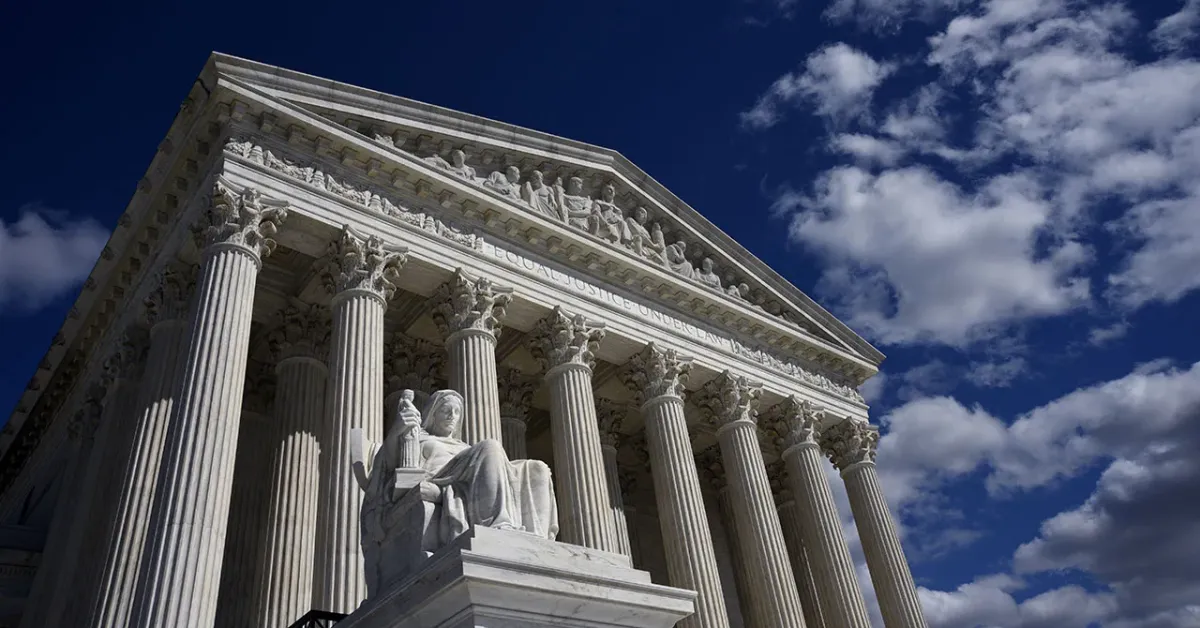
The US Supreme Court’s ruling in Mullin v. Doe and Trump v. Miot follows emergency lower-court orders in the Second Circuit and the D.C. Circuit that had delayed the Department of Homeland Security’s termination of Temporary Protected Status for Syria and Haiti.
The 25 June 2026 judgment narrows the dispute to the statutory limits on judicial review of TPS decisions, giving DHS a clearer route to end designations while litigation continues.
The Court held that 8 U.S.C. §1254a(b)(5)(A) bars judicial review of non-constitutional challenges to the Secretary of Homeland Security’s determinations on TPS designation, extension or termination.
Justice Samuel Alito delivered the opinion for the Court. Chief Justice John Roberts, Justice Clarence Thomas and Justice Brett Kavanaugh joined in full, while Justice Neil Gorsuch and Justice Amy Coney Barrett joined except for one part. Justice Elena Kagan dissented, joined by Justice Sonia Sotomayor and Justice Ketanji Brown Jackson.
The consolidated appeals placed Markwayne Mullin, President Donald J. Trump, Dahlia Doe and Fritz Emmanuel Lesly Miot in litigation over the scope of executive power in immigration relief. Syria received TPS in 2012 after the Assad regime’s repression and the civil war; Haiti received TPS in 2010 after the earthquake that devastated the country.
Federal Register notices recorded DHS decisions to terminate Syria’s designation at 11.59pm local time on 21 November 2025 and Haiti’s designation at 11.59pm local time on 3 February 2026, before lower-court orders postponed the effect of those terminations.
DHS, USCIS, ICE and the State Department are now positioned around implementation rather than judicial pause. The Court’s reasoning narrows the route for Administrative Procedure Act challenges alleging flawed consultation, inadequate country-condition analysis or arbitrary decision-making.
The remaining litigation space is constitutional, but the Court also found the Haitian respondents unlikely to succeed on their equal protection claim because the record supported a race-neutral explanation for the administration’s wider TPS policy.
For immigration lawyers, employment counsel and in-house legal teams, the decision creates an immediate workforce risk. TPS holders may lose work authorisation and protection from removal when a designation ends, so employers with Haitian or Syrian staff should review I-9 records, reverification dates and anti-discrimination duties before making staffing decisions.
Solicitors and US counsel advising affected families will also need to distinguish any surviving constitutional arguments from administrative-law claims that the Supreme Court has treated as outside judicial review.
The judgment matters beyond Haiti and Syria because the Trump administration has moved against multiple TPS designations using the same statutory framework. The next practical question is how DHS, USCIS and ICE will sequence termination notices, employment-authorisation consequences and enforcement decisions for Haiti, Syria and any other TPS designation that reaches review.