
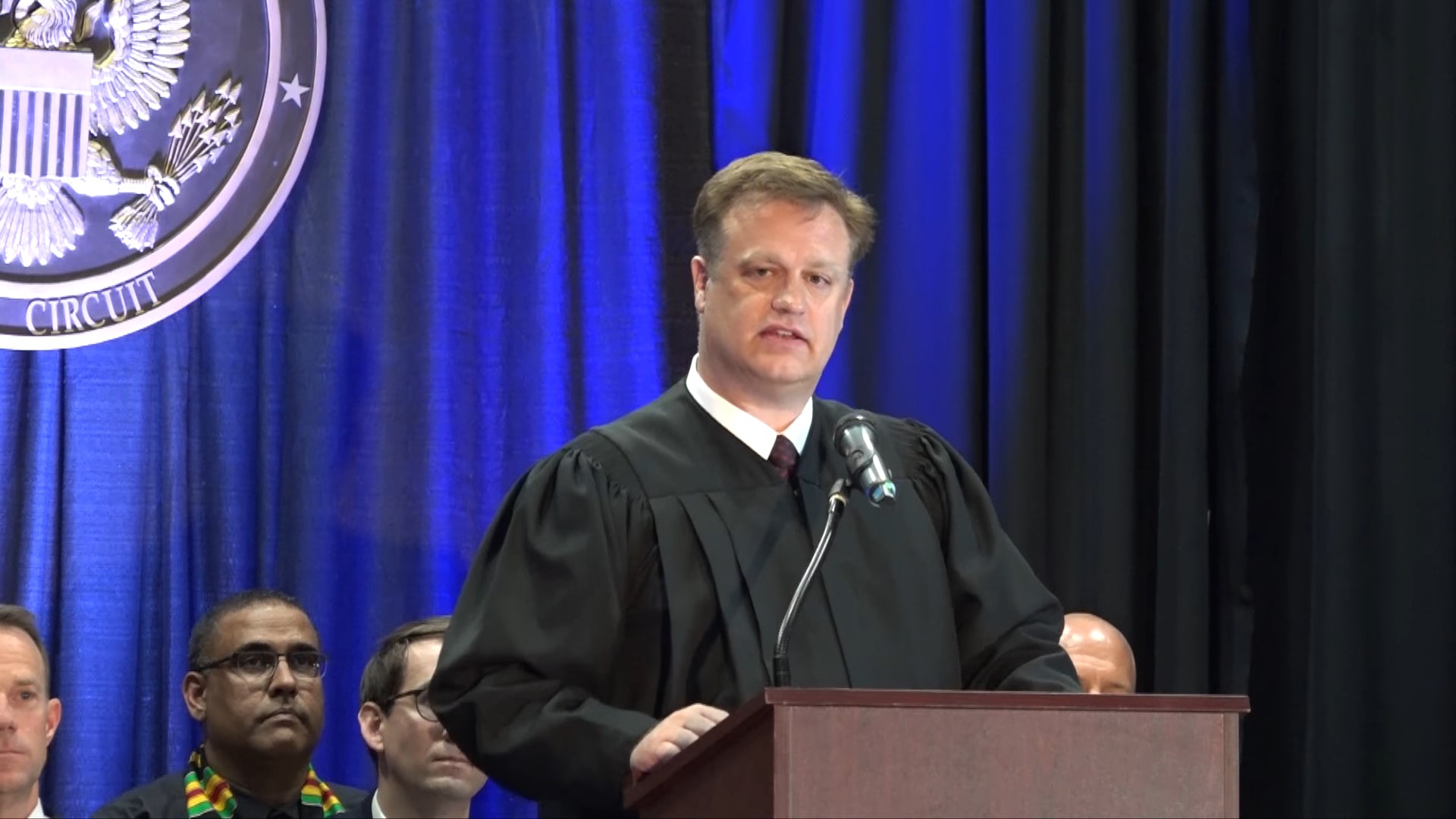
Judge Ryan D. Nelson’s rise on the 9th Circuit Court of Appeals has tracked the Trump administration’s push to remake the historically liberal court, and it is against that backdrop that a misdemeanor case out of Idaho Falls now threatens his standing.
Nelson was charged in late April with misdemeanor battery and malicious destruction of property following a parking-lot altercation with another driver, and he has pleaded not guilty.
Chief Circuit Judge Mary H. Murguia ordered a judicial misconduct inquiry after the incident became public in June. Murguia then asked U.S. Supreme Court Chief Justice John Roberts to transfer the inquiry out of the 9th Circuit to avoid any appearance of bias among colleagues who work with Nelson daily. Roberts assigned the matter to the 4th Circuit in Richmond, Va., this week.
The transfer places Nelson’s conduct before judges with no institutional stake in the outcome, a step law professor Carl Tobias of the University of Richmond described as necessary for collegiality among sitting judges.
The case also arrives as Nelson’s judicial record draws separate scrutiny: his concurrence backing the Department of Justice’s position that presidential authority to deploy troops domestically is unreviewable prompted a pointed dissent from fellow 9th Circuit Judge Jay Bybee.
Nelson had reached the same conclusion in an earlier panel with Judge Bridget S. Bade over National Guard deployments to Portland, and the underlying mobilizations were later struck down by the U.S. Supreme Court, which read the governing statute far more narrowly than Nelson had.
For litigators with matters before the 9th Circuit, and for in-house counsel weighing forum and appeal strategy in cases touching executive authority, the misconduct proceeding is now a factor to track alongside the substantive law.
A reprimand or other sanction from the 4th Circuit’s review would not disturb Nelson’s prior rulings, but it bears on recusal arguments and on how much weight practitioners give his reasoning in future panels, particularly on separation-of-powers questions where his views have already proven decisive to outcomes.
Firms handling executive-power litigation before the 9th Circuit should monitor the inquiry alongside Nelson’s continuing role in cases involving presidential authority and National Guard deployments. The proceeding does not affect his earlier rulings, but any formal finding by the 4th Circuit would attract attention from appellate practitioners assessing judicial ethics, recusal and public confidence in the court.
In-house teams following National Guard and domestic deployment disputes should keep the misconduct process separate from the legal merits of Nelson’s opinions. The value for practitioners lies in understanding how the federal judiciary handles allegations against a sitting appellate judge while related constitutional questions remain active before the courts.
Nelson is due back in Idaho state court on July 16, and the 4th Circuit’s misconduct review remains open with no announced timetable.