
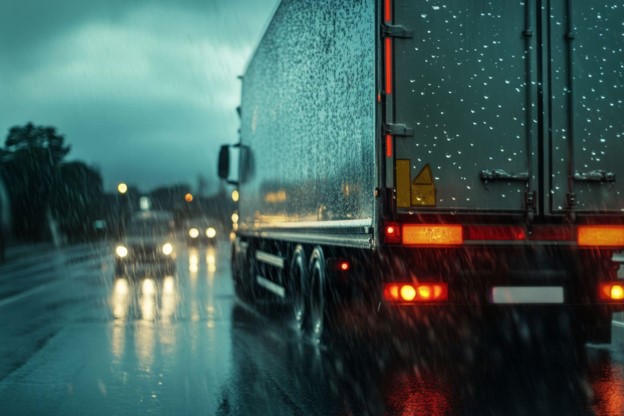
A loaded tractor-trailer needs far more room to stop than a car, and that gap grows the moment rain, ice, or heavy traffic enters the picture. Milton sits where Route 28, Route 138, and the ramps near I-93 funnel trucks through neighborhood streets and hills near the Blue Hills. A driver who misjudges a wet curve or a backed-up merge can turn a small mistake into a serious crash. Weather, traffic, and road conditions each play a part in why these crashes happen and who the law says should pay.
How Weather Turns Milton Roads Into a Danger Zone for Trucks
Rain, snow, and black ice cut a truck’s traction fast, and a loaded rig can need twice the stopping distance of a car in the same storm. Milton’s weather swings quickly between seasons, with snow off the Blue Hills and sudden downpours that pool on Adams Street. When a driver keeps highway speed through one of these changes, and a crash follows, sorting out whether the weather was truly unavoidable is often where a Milton truck accident lawyer can help compare the timeline against what a careful driver would have done.
Federal rules address this danger directly: 49 CFR § 392.14 requires truckers to use extreme caution and slow down, or stop, once weather starts to affect visibility or traction. A carrier that pushes a driver to keep a schedule through a storm is choosing profit over that rule.
Why Heavy Traffic Adds to the Risk of Truck Crashes in Milton
Milton carries a steady flow of trucks along Route 28, Route 138, and the connectors near the Neponset River, especially during the morning and evening commute. A loaded truck cannot dart between lanes or stop fast, so when traffic backs up near the Central Avenue rotary, drivers near a slow rig often misjudge how much room they have. A driver behind schedule who closes a gap too fast can turn a routine slowdown into a rear-end collision.
- Rush hour merges – trucks squeezing into gaps near I-93 exits
- Blind intersections – limited sightlines along Blue Hill Avenue crossings
- School zone slowdowns – trucks braking hard near Milton campuses
- Rotary congestion – trucks struggling to yield at the Central Avenue rotary
How Milton’s Road Conditions Raise the Chance of a Crash
Milton’s older streets add their own hazards, from tight curves on Randolph Avenue to hills near the Blue Hills that hide oncoming traffic. Poor drainage lets water pool after storms, and a heavy truck that hydroplanes even briefly can jackknife or drift into another lane. Faded lane lines and aging guardrails near these curves leave less room to correct a mistake.
State law does not let a posted speed limit serve as a shield when the road itself is the problem. Under Massachusetts General Laws Chapter 90, Section 17, every driver must slow below the posted limit when weather or road conditions create a special hazard. A truck driver who holds the limit through standing water can still be found negligent under this rule.
What Massachusetts Law Says About Fault in These Crashes
Weather and road conditions do not erase a truck driver’s duty to react safely, and courts weigh that duty against how much the conditions truly limited a careful driver. Under Massachusetts General Laws Chapter 231, Section 85, an injured person can still recover money if they share some blame, as long as their share stays at 50% or less. A victim found 30% at fault on a $100,000 claim still recovers $70,000.
Trucking companies often argue that weather made a crash unavoidable, since that shifts blame away from the driver. Under Massachusetts General Laws Chapter 260, Section 2A, an injured person has three years from the crash date to file suit, so gathering weather and road records early protects that window. Waiting too long can mean losing dash cam footage and maintenance logs that show the conditions were foreseeable.
How to Protect Your Claim After a Weather-Related Crash
The steps a driver takes in the minutes after a truck crash often decide how strong the claim becomes later. Weather and road conditions change fast, so that ice can melt and skid marks can fade before an adjuster ever sees the scene. Acting quickly preserves proof of what the road and weather actually looked like at the time of the crash.
- Call 911 – get police notes on weather and road conditions
- Take photos – capture ice, standing water, or skid marks
- Get witness names – collect contact information before people leave
- See a doctor – document injuries the same day as the crash
What These Milton Crash Patterns Mean Going Forward
Weather, traffic, and road design rarely cause a truck crash alone. They combine with a driver’s choices or a company’s scheduling to turn a routine drive into a collision. Milton’s mix of hills, rotaries, and seasonal storms will keep testing drivers on the same stretches of road for years to come. Anyone hurt in one of these crashes can benefit from having an injury attorney review the weather, traffic, and road records before valuing the claim.